
Introduction
Unsaturated polyester resin (UPR) is one of the most widely used thermosetting resins in composite manufacturing. Due to its excellent balance of mechanical performance, processing flexibility, corrosion resistance, and cost efficiency, UPR is widely used in industries such as FRP pipes, storage tanks, wind energy, marine products, construction materials, automotive components, artificial stone, and industrial equipment.
For composite manufacturers and material buyers, understanding unsaturated polyester resin properties is essential for selecting the right resin grade and achieving stable product performance.
Learn more about UPR resin selection for FRP applications and discover how different resin systems perform in demanding composite manufacturing environments.
Although different UPR formulations may appear similar, variations in chemical structure, viscosity, curing behavior, mechanical properties, and environmental resistance can significantly affect the final composite product.
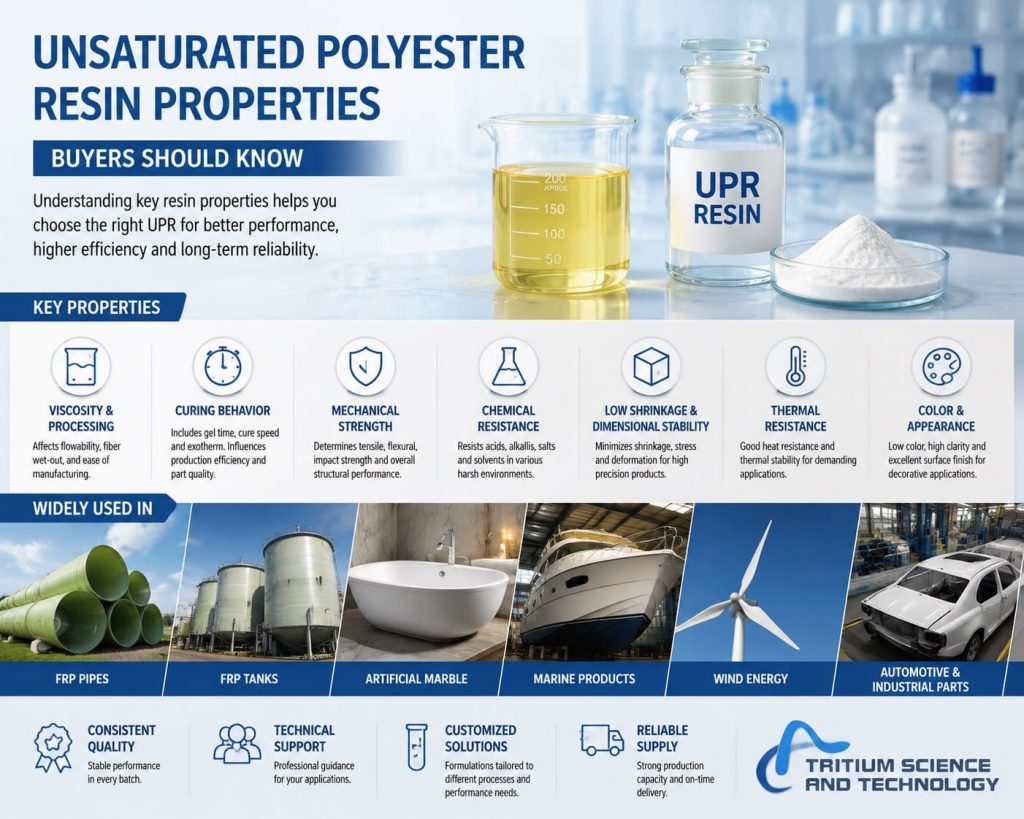
What Is Unsaturated Polyester Resin?
Unsaturated polyester resin is a thermosetting polymer produced by the reaction of unsaturated dibasic acids or anhydrides with polyols. It is usually supplied as a liquid resin solution containing reactive monomers such as styrene, which enables cross-linking during the curing process.
After adding a curing initiator, such as MEKP catalyst, the resin undergoes a chemical reaction and transforms from a liquid state into a strong, three-dimensional polymer network.
The main components of UPR systems include:
- Polyester polymer backbone
- Reactive monomers
- Curing additives
- Accelerators and performance modifiers
By adjusting the chemical structure and additives, manufacturers can develop resin grades with different characteristics for specific applications.
Key Unsaturated Polyester Resin Properties
1. Viscosity and Processing Performance
Viscosity is one of the first properties buyers should evaluate when selecting UPR.
Resin viscosity affects:
- Fiber wet-out
- Mixing performance
- Mold filling
- Production speed
- Surface quality
For processes such as hand lay-up, spray-up, filament winding, pultrusion, and casting, different viscosity ranges may be required.
A resin with suitable viscosity helps manufacturers achieve:
- Better reinforcement impregnation
- Reduced air bubbles
- More consistent production quality
2. Gel Time and Curing Characteristics
Curing performance directly influences manufacturing efficiency.
Important curing parameters include:
- Gel time
- Cure speed
- Peak exotherm
- Demolding time
A properly balanced curing system allows manufacturers to maintain stable production cycles.
For example:
- Fast curing resins improve productivity in high-volume production
- Longer gel time resins provide more working time for large structures
- Controlled exotherm helps prevent internal stress and cracking
Selecting the correct curing behavior according to the manufacturing process is essential.
3. Mechanical Strength
Mechanical properties determine how well a composite product performs under load.
Important parameters include:
- Tensile strength
- Flexural strength
- Impact resistance
- Elongation
- Hardness
In FRP applications, resin acts as the bonding matrix that transfers stress between reinforcement fibers.
A high-quality UPR system improves:
- Fiber bonding
- Structural stability
- Long-term durability
This is especially important for applications such as pipes, tanks, transportation components, and industrial structures.
4. Chemical Resistance
Chemical resistance is a key reason why UPR is widely used in industrial applications.
Different resin types provide different levels of resistance against:
- Acids
- Alkalis
- Salts
- Solvents
- Industrial chemicals
For demanding environments, manufacturers often select higher-performance resin systems, such as:
- Isophthalic polyester resin
- Vinyl ester resin
These materials provide improved corrosion resistance compared with standard general-purpose resins.
5. Shrinkage Control and Dimensional Stability
During curing, thermosetting resins experience volume changes.
Excessive shrinkage may cause:
- Cracks
- Warping
- Internal stress
- Surface defects
Low-shrinkage resin formulations help improve:
- Product accuracy
- Surface appearance
- Long-term reliability
This property is particularly important for:
- Large FRP tanks
- Composite panels
- Artificial marble
- Precision molded components
6. Thermal Resistance
Operating temperature is another important consideration when selecting UPR.
Resin performance at elevated temperatures depends on:
- Chemical structure
- Glass transition temperature (Tg)
- Heat distortion temperature (HDT)
Applications involving heat exposure, such as chemical equipment and industrial components, require resin systems with suitable thermal stability.
7. Color and Appearance
For decorative composite applications, resin appearance is an important factor.
Low-color and high-clarity resin systems are preferred for:
- Artificial marble
- Gel-coated products
- Decorative panels
- Transparent composite applications
Good color stability helps prevent yellowing and maintains product appearance over time.
Common Types of Unsaturated Polyester Resin
Orthophthalic Polyester Resin
General-purpose UPR offering:
- Good processing performance
- Cost efficiency
- Balanced mechanical properties
Common applications:
- General FRP products
- Construction materials
- Standard composite components
Isophthalic Polyester Resin
Provides improved:
- Water resistance
- Mechanical strength
- Durability
Common applications:
- FRP tanks
- Pipes
- Industrial equipment
DCPD Modified Polyester Resin
Known for:
- Low shrinkage
- Good surface quality
- Excellent processing characteristics
Common applications:
- Automotive components
- Molded composite products
- Industrial applications
Vinyl Ester Resin
Provides superior:
- Chemical resistance
- Toughness
- Temperature resistance
Common applications:
- Chemical storage tanks
- Corrosion-resistant equipment
- High-performance FRP structures
How Buyers Should Evaluate a UPR Resin Supplier
Choosing the right resin supplier is as important as selecting the resin itself.
Professional buyers should consider:
Product Consistency
A reliable supplier should provide stable:
- Viscosity
- Gel time
- Color
- Mechanical performance
Batch consistency is essential for continuous production.
Technical Support
Experienced suppliers should provide guidance on:
- Resin grade selection
- Manufacturing process optimization
- Catalyst adjustment
- Application requirements
Customized Resin Solutions
Different applications require different resin properties.
A professional China UPR resin manufacturer should be able to provide solutions based on:
- Product design
- Production process
- Performance requirements
- End-use environment
Why Choose ZhongTritium as Your UPR Resin Partner
ZhongTritium specializes in providing unsaturated polyester resin solutions for global composite manufacturers.
As an experienced China UPR resin manufacturer, ZhongTritium supports customers across industries including:
- FRP pipes and tanks
- Artificial marble
- Industrial composites
- Marine applications
- Construction materials
- Molded composite products
Our advantages include:
- Stable resin quality
- Application-oriented product recommendations
- Technical support for resin selection
- Customized solutions for different manufacturing processes
- Reliable supply capability
By combining manufacturing expertise with technical support, ZhongTritium helps customers achieve better product performance, improved efficiency, and more stable production.
Conclusion
Understanding unsaturated polyester resin properties is essential for selecting the right material for composite manufacturing.
Properties such as viscosity, curing behavior, mechanical strength, chemical resistance, shrinkage control, and thermal performance directly influence the quality and durability of final products.
By working with an experienced China UPR resin manufacturer like ZhongTritium, buyers can select suitable resin systems that match their production requirements and achieve reliable long-term performance.