
Introduction
As temperatures drop in winter, manufacturers using unsaturated polyester resin (UPR) may notice changes in curing behavior. Resin that normally reaches gelation within a predictable period may take significantly longer to cure, while molded products may remain tacky or fail to develop sufficient hardness within the expected production cycle.
These problems are particularly relevant to manufacturers producing FRP pipes, storage tanks, gratings, sanitary ware, artificial marble, and other composite products.
Low temperatures affect more than the surrounding air. Resin storage conditions, workshop temperature, mold temperature, and curing system compatibility can all influence the reaction rate. Understanding these factors is essential for maintaining stable production and consistent product quality during cold weather.
Why Does Polyester Resin Cure More Slowly in Cold Weather?
Unsaturated polyester resin cures through a free-radical polymerization reaction. In many conventional UPR systems, MEKP (methyl ethyl ketone peroxide) is used as the initiator, together with an appropriate accelerator system.
Temperature plays an important role in this reaction. As temperature decreases, the rate of polymerization generally slows down. This means that the resin may take longer to reach gelation and complete curing.
For manufacturers, the effects can include extended gel time, delayed demolding, incomplete curing, and reduced production efficiency.
However, low temperature is not always the only reason for slow curing. Incorrect catalyst dosage, poor mixing, unsuitable resin formulation, and inconsistent raw material conditions can produce similar symptoms.
Four Key Factors That Affect Resin Curing in Winter
1. Resin Storage and Material Temperature
The temperature of the resin itself is one of the first factors to check.
Even if the workshop temperature appears acceptable, resin stored in an unheated warehouse or transported during cold weather may enter production at a much lower temperature.
Cold resin generally has higher viscosity, which can make mixing and fiberglass impregnation more difficult. It may also affect the reaction behavior of the curing system.
For this reason, manufacturers should monitor resin temperature before production rather than relying solely on the room temperature reading.
Where temperature conditioning is necessary, resin should be brought gradually into the recommended processing range specified by the supplier. Heating must follow the product’s safety data sheet and handling instructions. Direct heating and uncontrolled temperature increases should be avoided.
2. Workshop and Mold Temperature
Workshop temperature directly affects the environment in which curing takes place. However, mold temperature is equally important and is sometimes overlooked.
For example, a workshop may be heated during winter, but metal molds, production tables, and equipment can remain cold. When resin comes into contact with these surfaces, heat is transferred away from the curing material, potentially extending gel time.
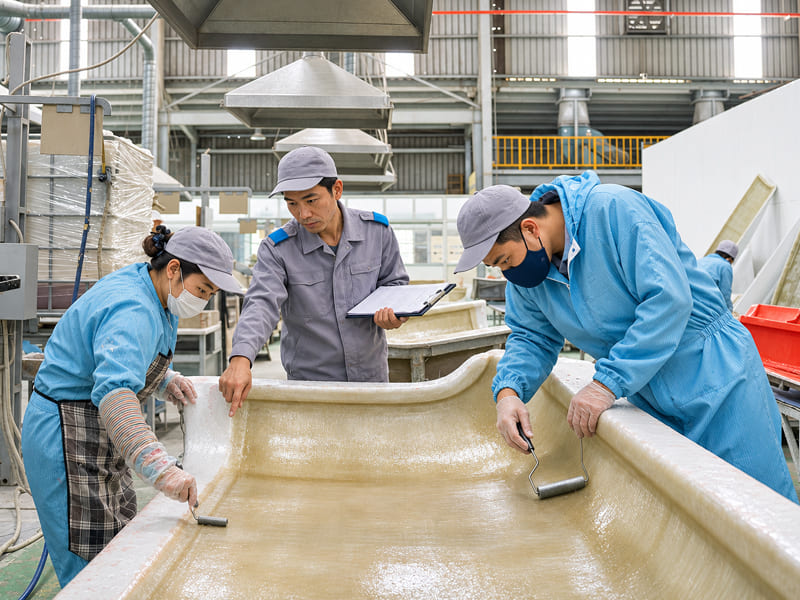
This is particularly important for hand lay-up, open molding, RTM, and other processes where mold temperature can influence the curing cycle.
Manufacturers should check the actual temperature of the resin, mold, and surrounding production environment to identify temperature differences that may affect curing consistency.
3. MEKP Dosage and Accelerator Compatibility
MEKP is commonly used as an initiator in unsaturated polyester resin systems. Its dosage influences curing behavior, but simply increasing the amount of MEKP is not a reliable solution to winter curing problems.
The appropriate dosage depends on the resin formulation, accelerator system, processing temperature, and required curing time.
An accelerator, commonly based on cobalt compounds in conventional systems, may also be incorporated into the resin formulation or supplied as part of a compatible curing system.
It is important to follow the resin manufacturer’s recommended formulation and dosage range. Excessive initiator or accelerator levels can lead to uncontrolled exothermic reactions, shortened working time, and potential product defects.
Important safety note: MEKP and cobalt accelerators must never be mixed directly together in concentrated form. They should be handled separately and used according to the supplier’s technical and safety instructions.
4. Resin Formulation and Application Requirements
Not all polyester resins respond to low temperatures in the same way.
Different resin grades are designed for different manufacturing processes and performance requirements. Their viscosity, reactive components, accelerator systems, and curing characteristics can vary significantly.
For example, resin used in hand lay-up may require a different gel-time profile from resin designed for pultrusion or filament winding.
A resin grade that performs well under normal workshop conditions may not provide the desired production cycle when temperatures fall substantially.
Manufacturers operating in colder environments should therefore discuss seasonal processing conditions with their resin supplier and evaluate whether a suitable low-temperature formulation is required.
How to Troubleshoot Polyester Resin That Is Not Curing
When polyester resin takes too long to cure, a systematic process check is more effective than immediately changing the catalyst dosage.
The following checks can help identify the source of the problem:
| Production Check | What to Look For |
|---|---|
| Resin temperature | Is the resin colder than the recommended processing range? |
| Workshop temperature | Is the production environment consistently maintained? |
| Mold temperature | Are cold molds absorbing heat from the resin? |
| Catalyst dosage | Is MEKP being used within the recommended range? |
| Mixing quality | Has the curing system been mixed uniformly? |
| Material condition | Are the resin and curing components within their specified shelf life and storage conditions? |
| Resin grade | Is the formulation suitable for the current process and temperature? |
Manufacturers should also distinguish between delayed gelation and incomplete curing. A resin that eventually gels but remains soft may indicate a different problem from one that simply takes longer to reach its gel point.
If the resin remains tacky or does not develop the expected hardness, further evaluation of the curing system, mixing procedure, and material compatibility may be necessary.
Practical Considerations for Different Composite Manufacturing Processes
Cold-weather curing challenges can vary depending on the production method.
In hand lay-up, resin and mold temperatures are particularly important because the material is exposed to the surrounding environment throughout application and curing.
In filament winding, stable resin viscosity and curing behavior are essential for continuous fiber impregnation and consistent pipe or pressure vessel production.
In pultrusion, resin reactivity must be matched carefully with die temperature, line speed, and residence time. An unsuitable curing profile can affect both production stability and the final profile properties.
For SMC and BMC compression molding, material conditioning, maturation characteristics, mold temperature, and the specified molding cycle all influence final product quality.
These differences highlight why resin selection should always consider the manufacturing process rather than relying on a single general-purpose formulation.
How to Maintain Stable Resin Curing During Winter Production
Maintaining consistent curing performance requires coordinated control of materials and production conditions.
Manufacturers should establish suitable storage conditions for resin and curing components, monitor actual material and mold temperatures, and maintain consistent mixing procedures. Temperature adjustments should be gradual and remain within the manufacturer’s recommendations.
It is also advisable to conduct small-scale curing tests when production conditions change significantly. Monitoring gel time, peak exotherm, and demolding performance can help identify potential problems before full-scale production begins.
For manufacturers with seasonal temperature variations, working with a resin supplier to evaluate suitable formulations can help reduce unexpected changes in processing behavior.
Conclusion
Slow polyester resin curing in cold weather is generally associated with reduced reaction rates, lower material temperatures, cold molds, and changes in curing conditions. However, the actual cause may involve several factors rather than temperature alone.
By monitoring resin and mold temperatures, checking MEKP dosage, maintaining proper mixing procedures, and selecting a resin grade suitable for the manufacturing process, composite manufacturers can improve winter production stability and reduce curing-related defects.
Understanding how resin formulations respond to different processing conditions is an important part of achieving consistent quality throughout the year.