
Fiber reinforced plastic (FRP) products are widely used in industries such as chemical processing, water treatment, oil & gas, marine engineering, and infrastructure due to their excellent corrosion resistance, lightweight structure, and long service life. Among various composite materials, FRP pipes, storage tanks, and gratings are some of the most common applications.
The performance of these products depends not only on the reinforcement materials, manufacturing process, and design structure, but also on the selection of the resin system. As the matrix material that bonds fibers together, unsaturated polyester resin (UPR) plays a critical role in determining chemical resistance, mechanical strength, durability, and overall product reliability.
For FRP manufacturers, selecting the right resin grade is essential to achieve stable production and meet demanding application requirements.
Understanding resin characteristics is also important before selecting a specific grade. Read our guide on unsaturated polyester resin properties to learn more about key performance factors.
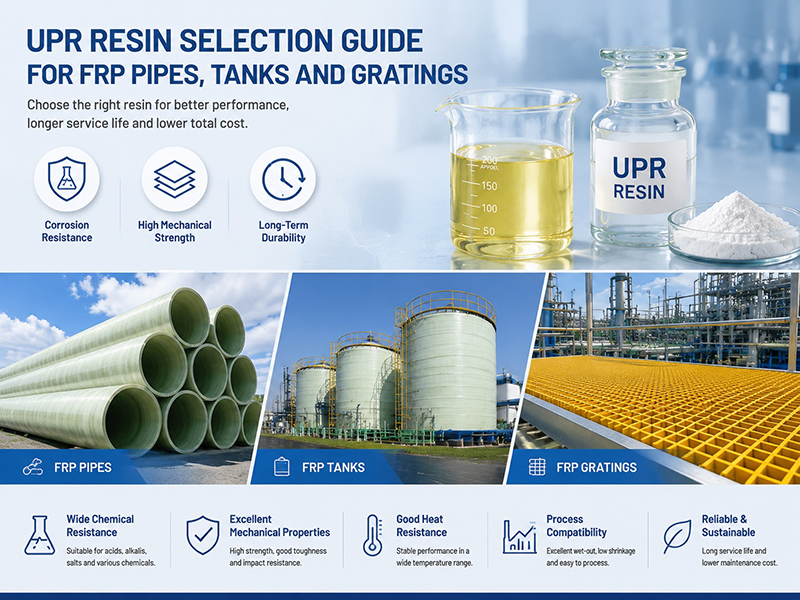
Why Resin Selection Matters for FRP Applications
In FRP manufacturing, resin serves several important functions:
- Bonds glass fibers into a strong composite structure
- Transfers loads between reinforcement layers
- Provides resistance against chemicals, moisture, and environmental exposure
- Determines curing behavior and production efficiency
- Influences surface quality and long-term durability
Although glass fiber provides most of the mechanical reinforcement, the resin system largely determines how well the composite performs in real operating conditions.
Using an unsuitable resin may result in:
- Poor chemical resistance
- Cracking or premature failure
- Reduced service life
- Surface defects
- Unstable production quality
Therefore, FRP manufacturers should select resin according to the specific application environment rather than focusing only on material cost.
Selecting UPR Resin for FRP Pipes
FRP pipes are commonly used for transporting corrosive liquids, wastewater, chemicals, and industrial fluids. These applications require excellent chemical resistance and mechanical stability.
When selecting resin for FRP pipes, manufacturers should consider:
Chemical Resistance
Different fluids require different levels of resistance. Pipes used for acids, alkalis, solvents, or industrial chemicals often require higher-performance resin systems.
Vinyl ester resin and specially designed chemical-resistant UPR systems are commonly selected for aggressive environments.
Mechanical Performance
FRP pipes must withstand internal pressure, external loads, and long-term operating stress.
A suitable resin should provide:
- High tensile strength
- Good fiber bonding
- Fatigue resistance
- Dimensional stability
Processing Compatibility
For manufacturing methods such as filament winding and centrifugal casting, resin viscosity and curing characteristics must match production requirements.
A well-balanced resin system helps improve fiber wet-out and reduce production defects.
Selecting UPR Resin for FRP Tanks
FRP tanks are widely used for chemical storage, water treatment, food processing, and industrial applications.
Because storage tanks are exposed to chemicals for long periods, resin selection is especially important.
Key considerations include:
Corrosion Resistance
The resin must withstand continuous contact with stored materials.
For chemical storage tanks, manufacturers should evaluate:
- Chemical concentration
- Operating temperature
- Exposure duration
- Required service life
Low Shrinkage Performance
Large FRP tanks require excellent dimensional stability.
High resin shrinkage may cause:
- Internal stress
- Cracking
- Surface distortion
Low-shrinkage resin systems help improve tank reliability and reduce maintenance requirements.
Surface Quality
The inner corrosion barrier of an FRP tank directly contacts the stored medium.
High-quality resin helps achieve:
- Smooth internal surfaces
- Better impermeability
- Reduced contamination risk
Selecting UPR Resin for FRP Gratings
FRP gratings are commonly used in chemical plants, offshore platforms, wastewater facilities, and industrial walkways.
Compared with metal alternatives, FRP gratings offer:
- Corrosion resistance
- Lightweight installation
- Electrical insulation
- Low maintenance requirements
When selecting resin for FRP gratings, manufacturers should focus on:
Weather and UV Resistance
Outdoor applications require resin systems with good resistance against sunlight, temperature changes, and environmental aging.
Mechanical Strength
FRP gratings must withstand:
- Foot traffic loads
- Impact forces
- Long-term outdoor exposure
The resin should provide strong bonding with fiberglass reinforcement to maintain structural integrity.
Fire Performance Requirements
For certain industrial applications, flame-retardant resin systems may be required to meet specific safety standards.
Common Resin Types Used in FRP Manufacturing
Different resin systems provide different performance characteristics.
Orthophthalic Polyester Resin
Orthophthalic UPR is commonly used for general-purpose FRP applications due to its cost efficiency and good processing performance.
Typical applications include:
- General FRP products
- Low-corrosion environments
- Standard industrial components
Isophthalic Polyester Resin
Isophthalic resin provides improved water resistance and mechanical performance.
It is suitable for:
- FRP tanks
- Pipes
- Industrial equipment
- Applications requiring better durability
Vinyl Ester Resin
For highly corrosive environments, vinyl ester resin provides superior chemical resistance and toughness.
Typical applications include:
- Chemical storage tanks
- Acid-resistant equipment
- High-performance FRP structures
How to Choose a Reliable UPR Resin Supplier
For FRP manufacturers, resin quality consistency is just as important as resin performance.
A reliable supplier should provide:
Stable Product Quality
Consistent viscosity, gel time, curing behavior, and mechanical properties are essential for continuous production.
Technical Support
Professional resin suppliers should help customers optimize:
- Resin selection
- Fiber ratio
- Catalyst dosage
- Processing parameters
Customized Solutions
Different FRP applications require different resin characteristics.
A professional China UPR resin manufacturer can provide customized solutions based on:
- Manufacturing process
- End-use environment
- Required performance
- Production conditions
Why Choose ZhongTritium for FRP Resin Solutions
ZhongTritium specializes in providing unsaturated polyester resin solutions for FRP applications, including pipes, tanks, gratings, and other composite products.
As an experienced China UPR resin manufacturer, ZhongTritium supports customers with:
- Application-specific resin recommendations
- Consistent batch quality
- Technical consultation
- Customized resin development
- Reliable global supply capability
Our resin solutions are designed to help FRP manufacturers improve production efficiency, enhance product performance, and achieve long-term reliability in demanding applications.
Conclusion
Choosing the right UPR resin is one of the most important factors in manufacturing high-quality FRP pipes, tanks, and gratings.
By considering chemical resistance, mechanical requirements, processing conditions, and service environment, manufacturers can select the optimal resin system for their applications.
Working with a professional China UPR resin manufacturer like ZhongTritium provides access to reliable resin products and technical support that help customers produce stronger, more durable, and higher-performance FRP products.