
High Performance Resin Guide for Compression Molding, Pultrusion & Winding
High performance composite manufacturing relies heavily on the right resin system. In processes such as compression molding, pultrusion, and filament winding, resin selection determines not only product strength and durability, but also production efficiency, fiber wet-out quality, and long-term stability.
Choosing the correct resin is therefore essential for manufacturers aiming to improve consistency and reduce defects in industrial FRP production.
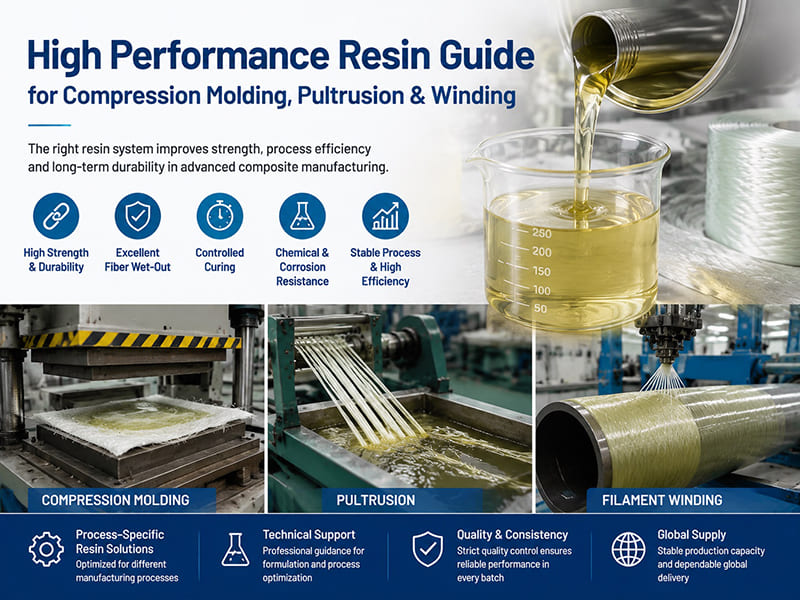
Understanding Resin Requirements in Different Processes
Each composite process places unique demands on resin performance.
In compression molding, the resin must provide balanced flow behavior, controlled curing, and strong adhesion to reinforcements under pressure. In pultrusion, continuous production requires fast curing, stable viscosity, and consistent mechanical performance. For filament winding, resin must ensure excellent fiber impregnation, controlled tack, and predictable curing to maintain structural integrity.
Because of these differences, selecting a generic resin often leads to performance instability. Instead, process-specific resin systems are required.
Key Resin Properties for High Performance Applications
1. Viscosity and Flow Behavior
Resin viscosity directly affects fiber wet-out and mold filling.
- Low viscosity improves fiber impregnation
- Controlled flow prevents resin loss and defects
- Stable rheology ensures consistent processing
Each process requires a different balance between flow and stability.
2. Curing Speed and Reactivity
Curing behavior is one of the most critical factors in industrial production.
- Pultrusion requires fast and continuous curing
- Compression molding requires controlled gel time
- Filament winding requires balanced curing for layer buildup
Improper curing leads to deformation, weak bonding, or production delays.
3. Mechanical Strength
High performance resins must deliver:
- High tensile and flexural strength
- Impact resistance
- Long-term fatigue performance
These properties ensure structural reliability in demanding applications such as construction, transportation, and energy systems.
4. Shrinkage Control
Low shrinkage is essential for dimensional accuracy.
Poor shrinkage control may cause:
- Warping
- Internal stress
- Surface cracking
Advanced resin formulations help maintain dimensional stability in complex geometries.
5. Fiber Compatibility
Good resin must fully wet fiberglass or carbon fiber reinforcement.
This ensures:
- Strong interfacial bonding
- Uniform stress distribution
- Improved composite lifespan
Resin Selection by Process Type
Compression Molding
Requires resins with balanced flow, moderate curing speed, and high surface quality performance.
Pultrusion
Requires fast-curing, low-viscosity resins with stable continuous processing behavior.
Filament Winding
Requires controlled wet-out, adjustable viscosity, and predictable curing for layered structures.
Common Problems Caused by Incorrect Resin Selection
Many production issues in FRP manufacturing originate from unsuitable resin systems:
- Incomplete fiber wet-out
- Excessive voids or bubbles
- Poor dimensional accuracy
- Weak interlaminar bonding
- Unstable production cycles
These issues can often be eliminated through proper resin selection rather than process modification alone.
Why Work with a China UPR Resin Manufacturer
Working with a specialized supplier is critical for achieving stable and high-quality production.
As a professional China UPR resin manufacturer, ZhongTritium provides resin systems tailored for compression molding, pultrusion, and filament winding applications.
Our support includes:
- Customized resin formulations
- Process-specific technical guidance
- Stable batch-to-batch quality control
- Testing and sample support before mass production
- Global supply capability for industrial customers
By matching resin systems to real production conditions, manufacturers can significantly improve efficiency and reduce defect rates.
Conclusion
High performance resin selection is the foundation of successful composite manufacturing. Compression molding, pultrusion, and filament winding each require specific resin properties to achieve optimal performance.
By selecting the right resin system and working with an experienced China UPR resin manufacturer like ZhongTritium, manufacturers can enhance product quality, improve production efficiency, and ensure long-term structural reliability.