
Pultrusion has become one of the most important continuous manufacturing processes for producing high-performance fiber reinforced polymer (FRP) profiles. Due to their lightweight structure, corrosion resistance, and long service life, pultruded FRP products are widely used in construction, infrastructure, electrical, chemical, and industrial applications.
Although fiberglass reinforcement provides the primary strength in FRP profiles, the resin system plays an equally important role in determining product performance. The resin binds the fibers together, transfers loads between reinforcement layers, and influences key properties such as corrosion resistance, dimensional stability, surface quality, and long-term durability.
For manufacturers producing pultruded profiles, selecting the right pultrusion resin is essential to achieving stable production and consistent product performance.
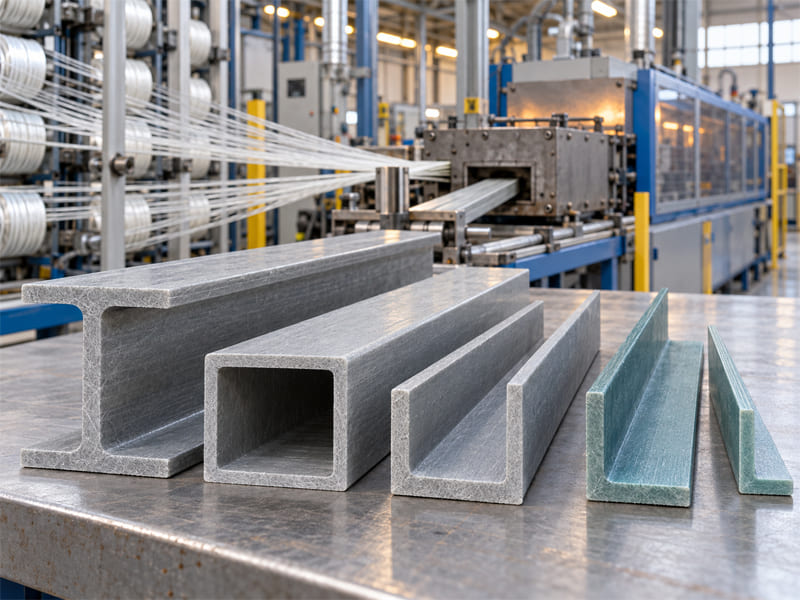
1.What Is Pultrusion and Why Does Resin Matter?
Pultrusion is a continuous composite manufacturing process where continuous fibers are pulled through a resin bath, impregnated with resin, and then passed through a heated die for curing.
Unlike traditional molding methods, pultrusion requires the resin system to meet specific processing requirements because the material must continuously pass through the production line at a controlled speed.
During this process, the resin needs to provide:
- Excellent fiber wet-out
- Stable curing behavior
- Good adhesion with reinforcement
- Low shrinkage
- Consistent surface quality
A poorly selected resin can lead to production issues such as incomplete curing, surface defects, poor mechanical properties, and reduced service life.
2.Common Resin Systems Used in Pultrusion
Several thermosetting resin systems can be used for pultrusion, including unsaturated polyester resin, vinyl ester resin, and epoxy resin.
Among them, unsaturated polyester resin (UPR) is one of the most widely used options because it provides a good balance between performance, processing efficiency, and cost.
3.Unsaturated Polyester Resin for Pultrusion Applications
Unsaturated polyester resin is commonly selected for pultruded FRP profiles due to its excellent processing characteristics and versatility.
The advantages of UPR resin include:
Good Processing Efficiency
Pultrusion requires continuous and stable production. UPR resin provides suitable viscosity and curing characteristics, allowing efficient fiber impregnation and smooth operation.
Cost-Effective Performance
Compared with some high-performance resin systems, UPR offers competitive cost while still providing reliable mechanical strength and environmental resistance.
This makes it suitable for large-volume FRP profile production where both performance and economics are important.
Wide Application Compatibility
UPR resin can be formulated for different pultrusion requirements, including profiles used in construction, electrical insulation, industrial equipment, and corrosion-resistant structures.
4.Key Resin Properties for Pultruded FRP Profiles
Choosing a resin for pultrusion requires more than simply comparing strength values. The resin must match the production process and final application requirements.
4.1Viscosity and Fiber Wet-Out
Viscosity is one of the most important factors in pultrusion resin selection.
The resin must be fluid enough to completely penetrate the fiber bundle while maintaining sufficient resin content and avoiding excessive drainage.
Proper wet-out helps:
- Improve fiber bonding
- Reduce internal voids
- Increase mechanical performance
- Produce a uniform composite structure
4.2Curing Speed and Thermal Performance
Pultrusion is a continuous process, which means curing behavior must be carefully controlled.
A suitable resin should provide:
- Stable gel time
- Controlled curing speed
- Good reaction consistency
- Proper heat release during curing
If curing occurs too quickly, processing problems may occur inside the die. If curing is too slow, production efficiency may decrease.
4.3Mechanical Strength and Dimensional Stability
FRP profiles are often used as structural components, making mechanical performance a critical consideration.
The resin system contributes to:
- Tensile strength
- Flexural strength
- Impact resistance
- Load transfer efficiency
Low shrinkage resin formulations also help reduce internal stress, deformation, and dimensional changes after curing.
4.4Corrosion and Environmental Resistance
Many pultruded FRP profiles are used in harsh environments, including chemical plants, wastewater facilities, coastal areas, and outdoor structures.
The resin should provide resistance against:
- Moisture
- Chemicals
- Corrosive environments
- Temperature changes
- UV exposure
For more demanding applications, specially formulated resin systems may be selected to improve long-term durability.
5.Pultrusion Resin Selection for Different Applications
Different FRP profile applications require different resin characteristics.
5.1Construction and Infrastructure
For applications such as bridges, walkways, handrails, and structural profiles, manufacturers usually prioritize:
- Mechanical strength
- Weather resistance
- Dimensional stability
- Long service life
5.2Electrical Applications
FRP profiles used for electrical insulation require:
- Excellent electrical properties
- Low moisture absorption
- Stable performance under environmental conditions
5.3Chemical and Industrial Applications
For chemical equipment, platforms, and structural components, resin selection should focus on:
- Corrosion resistance
- Chemical stability
- Durability under harsh conditions
The optimal resin choice depends on the operating environment and expected service requirements.
6.Common Pultrusion Problems Caused by Improper Resin Selection
Using an unsuitable resin system may create challenges during production and reduce final product quality.
Common issues include:
6.1Poor Fiber Impregnation
Incorrect viscosity may prevent complete fiber wet-out, resulting in weak areas inside the profile.
6.2Surface Defects
Poor curing control or resin compatibility issues may cause rough surfaces, cracks, or uneven appearance.
6.3Dimensional Instability
High shrinkage or improper curing behavior can lead to deformation and inconsistent profile dimensions.
6.4Reduced Service Life
A resin that does not match the application environment may result in premature aging, corrosion damage, or performance loss.
7.How to Choose a Reliable Pultrusion Resin Supplier
For FRP profile manufacturers, resin consistency is critical to maintaining stable production.
A reliable resin supplier should provide:
- Consistent resin quality between batches
- Application-specific resin grades
- Technical support for process optimization
- Stable supply capability
The right supplier can help manufacturers adjust resin selection according to fiber type, production speed, curing conditions, and final application requirements.
8.How ZhongTritium Supports Pultrusion Applications
ZhongTritium provides unsaturated polyester resin solutions for a wide range of composite applications.
With experience in resin manufacturing and global supply, ZhongTritium supports customers producing:
- FRP profiles
- Pipes and tanks
- Gratings
- Industrial composite components
- High-performance structural products
Our resin solutions are developed to provide reliable processing performance, durability, and cost efficiency for different composite manufacturing requirements.
Conclusion
Selecting the right pultrusion resin is a key factor in producing strong, stable, and durable FRP profiles.
Unsaturated polyester resin remains one of the most widely used resin systems for pultrusion because of its excellent balance of processing performance, mechanical properties, corrosion resistance, and cost effectiveness.
By matching resin characteristics with production conditions and application requirements, manufacturers can improve product quality, reduce defects, and achieve more reliable long-term performance.
For companies seeking a reliable China UPR resin manufacturer, choosing a supplier with technical expertise and consistent quality is essential for successful composite manufacturing.