
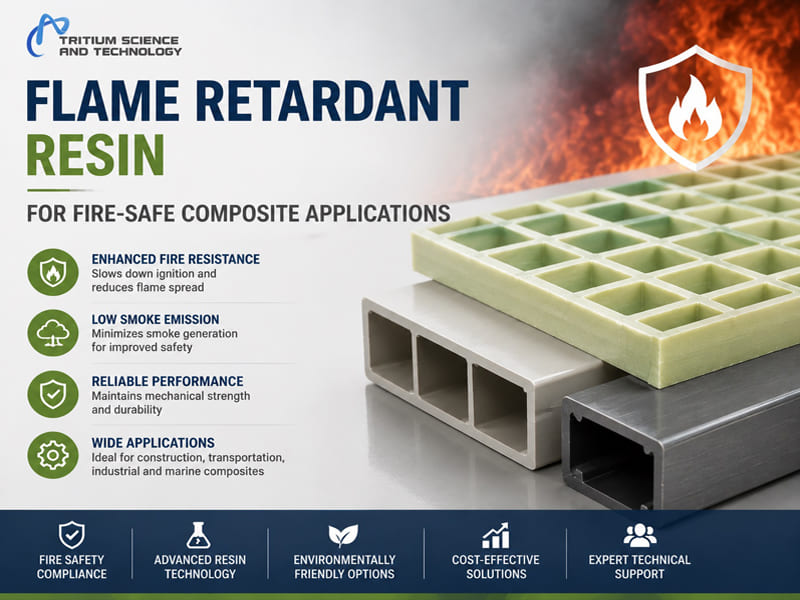
What Is Flame Retardant Resin?
Flame retardant resin is a specially formulated thermosetting resin designed to reduce the spread of fire and improve the fire performance of composite materials.
Unlike standard resin systems, flame retardant resins contain specific chemical structures or additives that help:
- Delay ignition
- Reduce flame propagation
- Lower heat release
- Minimize smoke generation
- Maintain structural integrity under elevated temperatures
In FRP applications, the resin acts as the matrix material that surrounds and protects reinforcing fibers. Therefore, the flame performance of the resin directly influences the overall fire behavior of the composite product.
Why Fire Performance Matters in Composite Applications
Traditional FRP materials provide excellent advantages such as:
- Lightweight structure
- Corrosion resistance
- High strength-to-weight ratio
- Easy fabrication
However, standard polyester resins are organic polymer materials and may burn when exposed to high temperatures or flames.
In industries with strict fire safety requirements, conventional resin systems may not meet application standards.
Flame retardant resin helps composite manufacturers develop products with improved fire resistance for environments such as:
- Public buildings
- Transportation systems
- Chemical facilities
- Electrical equipment
- Offshore and marine structures
Key Properties of Flame Retardant Resin
1. Flame Resistance and Reduced Flame Spread
The primary function of flame retardant resin is to slow down combustion.
A high-performance flame retardant resin system helps:
- Reduce ignition speed
- Limit flame spreading
- Improve fire safety performance
This is especially important for composite components installed in enclosed or high-risk environments.
2. Low Smoke Generation
During a fire, smoke production can create significant safety risks.
Flame retardant resin formulations can help reduce:
- Smoke density
- Toxic gas release
- Visibility reduction during fire events
For applications such as transportation and public infrastructure, low-smoke characteristics are often critical requirements.
3. Maintaining Mechanical Performance
A common challenge in flame retardant composites is balancing fire resistance with mechanical properties.
A suitable resin system should maintain:
- Tensile strength
- Flexural strength
- Impact resistance
- Fiber bonding performance
High-quality flame retardant resins allow manufacturers to achieve improved fire safety while maintaining reliable structural performance.
4. Processing Compatibility
For composite manufacturers, resin processing performance is equally important.
Key parameters include:
- Viscosity
- Gel time
- Cure speed
- Fiber wet-out capability
A flame retardant resin should be compatible with existing manufacturing processes such as:
- Hand lay-up
- Spray-up
- Pultrusion
- Filament winding
- Resin casting
Common Flame Retardant Resin Technologies
Halogen-Free Flame Retardant Resin
Halogen-free systems are increasingly preferred because they provide improved environmental performance and reduced toxic emissions during combustion.
Advantages include:
- Lower smoke generation
- Better environmental compatibility
- Suitable for applications with strict safety requirements
Modified Unsaturated Polyester Resin
Modified UPR systems improve fire resistance through:
- Special molecular structures
- Flame retardant additives
- Performance modifiers
These resins are widely used in industrial composite applications requiring balanced cost and performance.
Vinyl Ester Flame Retardant Resin
For more demanding environments, flame retardant vinyl ester resin can provide:
- Excellent chemical resistance
- Higher durability
- Improved thermal performance
It is often selected for advanced industrial and corrosion-resistant applications.
Applications of Flame Retardant Composite Materials
FRP Gratings and Platforms
Flame retardant FRP gratings are widely used in:
- Chemical plants
- Offshore facilities
- Industrial platforms
They provide corrosion resistance while improving fire safety.
Transportation Composites
Fire-resistant composite materials are increasingly used in:
- Railway components
- Marine interiors
- Automotive parts
Lightweight construction combined with improved fire performance helps meet modern transportation requirements.
Industrial Equipment and Structures
Flame retardant resin is suitable for:
- Chemical equipment
- Electrical components
- Ventilation systems
- Industrial panels
These applications require both durability and enhanced fire protection.
How to Select the Right Flame Retardant Resin
Choosing the right resin depends on several factors:
Application Environment
Consider:
- Fire exposure risk
- Temperature conditions
- Chemical environment
- Outdoor or indoor use
Manufacturing Process
Different processes require different resin characteristics.
For example:
- Pultrusion requires stable curing and suitable viscosity
- Filament winding requires excellent fiber wet-out
- Hand lay-up requires good working time
Required Fire Performance
Manufacturers should evaluate:
- Flame resistance level
- Smoke requirements
- Applicable standards
- End-use regulations
A professional resin supplier can help select the appropriate formulation based on these requirements.
Why Choose ZhongTritium for Flame Retardant Resin Solutions?
ZhongTritium specializes in the manufacturing and exporting of resin solutions for global composite industries.
With three member factories, including two 300,000-ton production facilities and one 200,000-ton factory under construction, supported by a CNAS-certified R&D center, ZhongTritium provides stable resin supply and technical support for customers worldwide.
Our resin solutions are recognized for their:
- High durability
- Corrosion resistance
- Cost-effectiveness
- Reliable processing performance
ZhongTritium provides resin solutions for applications including:
- FRP pipes
- FRP tanks
- FRP gratings
- Marine composites
- Industrial components
- Fire-resistant composite products
By combining manufacturing capability with technical expertise, ZhongTritium helps customers develop safer, more durable, and high-performance composite solutions.
As fire safety requirements continue to increase, flame retardant resin has become an important material solution for advanced composite applications.
The right resin system can help manufacturers achieve improved flame resistance, reduced smoke generation, reliable mechanical performance, and long-term durability.
By selecting a professional China UPR resin manufacturer, composite producers can obtain customized flame retardant resin solutions that meet specific application and performance requirements.