
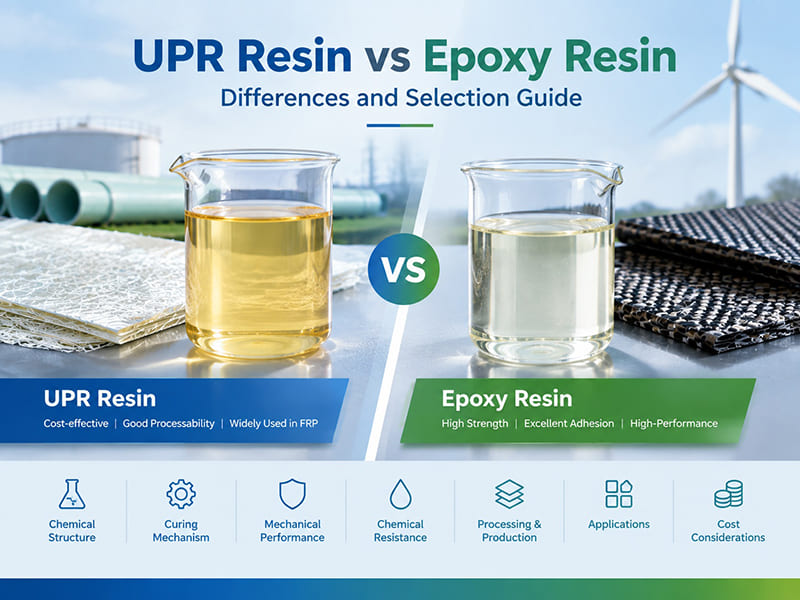
In composite manufacturing, choosing the right resin system is one of the most important decisions affecting product performance, production efficiency, and long-term durability.
Among thermosetting resins, unsaturated polyester resin (UPR) and epoxy resin are two of the most widely used materials. Both provide excellent bonding performance and mechanical properties, but they are designed for different application requirements.
UPR resin is widely used in large-scale composite manufacturing due to its cost efficiency, fast processing, and compatibility with various production methods. Epoxy resin is often selected for high-performance applications requiring superior mechanical strength, chemical resistance, and bonding performance.
Rather than determining which resin is universally better, manufacturers should select the resin system that best matches their production process, performance requirements, and application environment.
1.What Is Unsaturated Polyester Resin (UPR)?
Unsaturated polyester resin (UPR) is one of the most commonly used thermosetting resins in the composite industry.
UPR contains reactive double bonds that allow it to cure through cross-linking reactions, usually with catalysts such as MEKP. After curing, the resin forms a rigid polymer network that provides strength, durability, and resistance to environmental conditions.
Due to its balance of performance and cost, UPR resin is widely used in:
- FRP pipes
- Storage tanks
- FRP gratings
- Sanitary ware
- Artificial marble
- Marine composites
- Automotive components
One of the major advantages of UPR is its adaptability to different manufacturing processes, including hand lay-up, filament winding, pultrusion, RTM, and compression molding.
2.What Is Epoxy Resin?
Epoxy resin is a high-performance thermosetting resin known for its excellent mechanical properties and strong adhesion.
Unlike UPR, epoxy resin cures through a reaction between epoxy compounds and curing agents, forming a highly cross-linked structure.
Epoxy resin is commonly selected for applications requiring:
- High mechanical strength
- Excellent adhesion
- Low shrinkage
- Superior chemical resistance
- High-temperature performance
Typical applications include:
- Aerospace composites
- Wind energy components
- Carbon fiber structures
- Electronic encapsulation
- High-performance adhesives
- Industrial repair systems
Because of its higher performance characteristics, epoxy resin is often used in applications where maximum strength and reliability are more important than cost efficiency.
3.Key Differences Between UPR Resin and Epoxy Resin
3.1Chemical Structure and Curing Mechanism
The main difference between UPR and epoxy resin comes from their chemical structures and curing methods.
UPR resin typically uses free-radical polymerization initiated by catalysts such as MEKP. This allows relatively fast curing and makes it suitable for high-volume composite production.
Epoxy resin cures through a chemical reaction between epoxy groups and curing agents. This reaction creates a highly cross-linked network, resulting in excellent mechanical properties and adhesion.
The different curing mechanisms influence processing requirements, production speed, and final material performance.
3.2Mechanical Performance Comparison
Epoxy resin generally provides higher mechanical strength and better adhesion compared with standard polyester resin.
Its advantages include:
- Higher tensile strength
- Better fatigue resistance
- Superior fiber bonding
- Lower internal stress
For demanding structural applications such as aerospace or advanced carbon fiber components, epoxy is often preferred.
UPR resin provides a very good balance between mechanical performance and production cost. When reinforced with fiberglass, UPR composites offer sufficient strength and durability for many industrial applications.
For products such as FRP tanks, pipes, and gratings, UPR remains one of the most widely used resin systems because it delivers reliable performance at a competitive cost.
4.Processing Performance and Production Efficiency
For manufacturers, processing characteristics are often as important as final material properties.
UPR resin offers several production advantages:
- Fast curing speed
- Easy processing
- Compatibility with multiple molding methods
- Large-scale manufacturing capability
These advantages make UPR suitable for industries producing large quantities of composite products.
Epoxy resin usually requires more precise processing control, including mixing ratios, curing conditions, and temperature management. While it provides excellent performance, production costs and processing requirements are generally higher.
Therefore, manufacturers producing large FRP components often choose UPR resin when cost efficiency and production flexibility are important considerations.
5.Chemical Resistance and Environmental Durability
Both UPR and epoxy resin can provide good chemical resistance, but their performance depends on the specific formulation and application environment.
UPR resin can be modified to provide excellent resistance against:
- Water
- Chemicals
- Corrosion
- Industrial environments
Special grades such as vinyl ester resin offer even higher chemical resistance for demanding applications.
Epoxy resin provides excellent resistance to many chemicals and solvents, making it suitable for harsh environments requiring strong bonding and durability.
The right choice depends on factors such as chemical exposure, temperature, moisture, and expected service life.
6.Cost Considerations
Cost is an important factor in industrial composite manufacturing.
UPR resin is widely used because it offers:
- Lower material cost
- Efficient processing
- Good overall performance
- Large-scale availability
This makes it suitable for industries where performance and cost need to be balanced.
Epoxy resin generally has a higher material cost due to its advanced performance characteristics. It is typically selected when the application requires superior mechanical properties or extreme durability.
For many industrial FRP applications, UPR provides the most practical combination of performance and economic efficiency.
7.UPR Resin vs Epoxy Resin: Application Comparison
7.1Applications Suitable for UPR Resin
UPR resin is commonly selected for:
- FRP pipes
- Chemical storage tanks
- FRP gratings
- Cooling towers
- Sanitary products
- Artificial stone
- Marine components
These applications benefit from UPR’s balance of strength, corrosion resistance, and manufacturing efficiency.
7.2Applications Suitable for Epoxy Resin
Epoxy resin is often used in:
- Aerospace structures
- Carbon fiber composites
- High-performance sporting equipment
- Electronic applications
- Advanced industrial bonding
These applications typically require maximum mechanical performance and superior adhesion.
8.How to Choose Between UPR Resin and Epoxy Resin?
The best resin choice depends on several factors:
8.1Application Requirements
Consider:
- Required mechanical strength
- Chemical exposure
- Temperature conditions
- Service life expectations
8.2Manufacturing Process
Different processes require different resin characteristics.
UPR is widely compatible with:
- Hand lay-up
- Filament winding
- Pultrusion
- RTM
- Compression molding
Epoxy is commonly used in processes requiring precise performance control.
8.3Cost and Production Volume
For large-scale industrial production, UPR often provides better cost efficiency.
For specialized applications where performance is the top priority, epoxy may provide advantages.
9.How ZhongTritium Supports Resin Selection
Selecting the right resin system requires a clear understanding of product requirements, processing conditions, and performance expectations.
ZhongTritium provides resin solutions for global composite manufacturers, supporting applications including:
- FRP pipes
- Storage tanks
- Gratings
- Sanitary products
- Marine composites
- Industrial components
Our technical team helps customers evaluate resin characteristics based on application requirements, manufacturing methods, and desired performance.
By choosing the appropriate resin system, manufacturers can achieve better product quality, improved production efficiency, and reliable long-term performance.
Conclusion
Both UPR resin and epoxy resin play important roles in modern composite manufacturing.
UPR resin offers excellent cost efficiency, processing flexibility, and reliable performance for a wide range of industrial FRP applications. Epoxy resin provides higher mechanical performance and superior bonding properties for advanced applications requiring maximum durability.
The right choice depends on the specific application, production process, and performance requirements.
For manufacturers seeking a reliable China UPR resin manufacturer, selecting a supplier with strong technical knowledge and consistent resin quality is essential for developing successful composite solutions.