
In modern composite manufacturing, compression molding has become an important production method for producing lightweight, durable, and high-performance components. Among the most widely used compression molding materials are Sheet Molding Compound (SMC) and Bulk Molding Compound (BMC).
Both SMC and BMC rely on unsaturated polyester resin (UPR) as the polymer matrix, combined with fiberglass reinforcement, mineral fillers, curing agents, and performance additives. Although they share similar material foundations, the differences in resin formulation, fiber structure, processing behavior, and final applications make them suitable for different manufacturing requirements.
For composite manufacturers, choosing between SMC resin and BMC resin is not simply a matter of selecting a material. The resin system must match the molding process, product design, production efficiency requirements, and expected service performance.
Understanding SMC and BMC Composite Materials
SMC and BMC are both thermosetting composite materials, but they differ mainly in their physical form and manufacturing process.
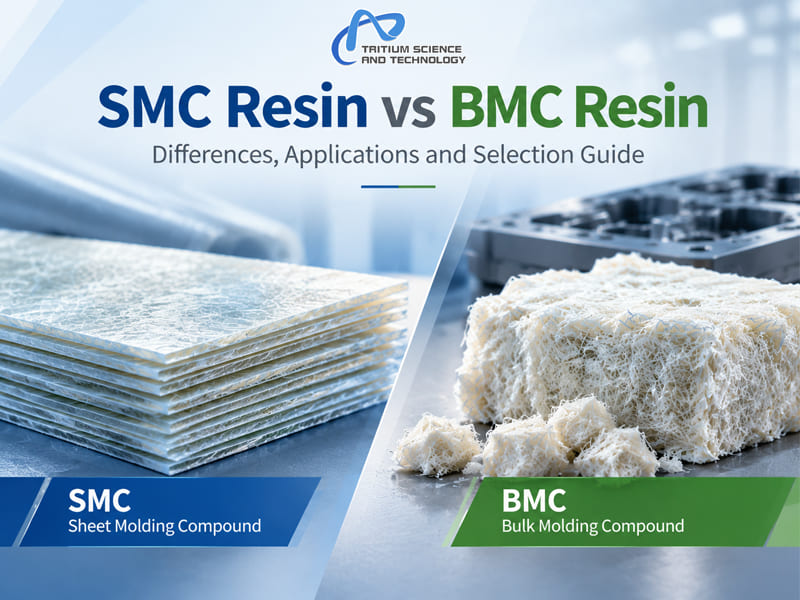
SMC, or Sheet Molding Compound, is produced by combining resin paste with chopped glass fibers and fillers to form a sheet material. After a maturation period, the material reaches suitable handling characteristics and is compression molded under controlled temperature and pressure.
Because SMC uses relatively longer fiberglass reinforcement and provides excellent mechanical properties, it is widely used for larger structural components where strength, stiffness, and surface appearance are important.
BMC, or Bulk Molding Compound, is produced by mixing resin, chopped fibers, fillers, and additives into a bulk dough-like compound. Compared with SMC, BMC generally uses shorter fibers, which provides better flowability and allows the material to fill complex molds more easily.
This makes BMC particularly suitable for precision components with complicated geometries and high-volume production requirements.
Why Resin Selection Is Critical for SMC and BMC Production
Although reinforcement fibers contribute significantly to composite strength, the resin system determines how effectively the fibers are bonded together and how the material performs during processing and service.
For SMC production, the resin must provide controlled viscosity, stable thickening behavior, and excellent fiber wet-out. During sheet production and molding, the resin needs to maintain proper flow characteristics while ensuring good surface quality and dimensional stability.
For BMC production, resin flow performance becomes even more important. Since BMC materials need to fill complex molds under pressure, the resin must achieve a balance between fluidity, curing speed, and final mechanical performance.
A resin that is not properly matched to the process may result in:
- Poor fiber impregnation
- Surface defects
- Uneven curing
- Internal voids
- Reduced mechanical performance
Therefore, selecting the correct UPR resin grade is one of the key factors determining final product quality.
Key Differences Between SMC Resin and BMC Resin
Processing Characteristics
The biggest difference between SMC and BMC lies in their processing requirements.
SMC resin systems are designed for sheet production and compression molding. The resin needs to provide stable viscosity development during maturation, allowing the compound to be stored, transported, and molded consistently.
In contrast, BMC resin systems focus more on flow performance. During molding, the material must quickly fill the entire cavity while maintaining fiber distribution and preventing defects.
For manufacturers producing large structural parts, SMC resin provides better reinforcement efficiency. For manufacturers producing small and complex components, BMC resin offers better mold-filling capability.
Mechanical Performance and Product Design Considerations
SMC composites generally achieve higher mechanical strength because of their longer fiber reinforcement structure.
This makes SMC suitable for applications requiring:
- High stiffness
- Structural strength
- Impact resistance
- Lightweight design
Typical examples include automotive body panels, electrical cabinets, transportation components, and industrial covers.
BMC composites focus more on precision and molding flexibility. Although the mechanical properties may be lower compared with SMC, BMC provides excellent dimensional accuracy and surface quality.
It is commonly selected for:
- Electrical components
- Switchgear housings
- Automotive precision parts
- Industrial molded components
The choice between SMC and BMC should therefore be based on the final product requirements rather than simply comparing resin performance.
Surface Quality and Appearance Requirements
For many composite products, appearance is an important purchasing factor.
SMC is widely used for visible structural components because advanced resin formulations can provide:
- Smooth surfaces
- Good paint adhesion
- Reduced surface defects
- Stable color appearance
This is particularly important in automotive and architectural applications.
BMC, due to its excellent molding capability, can reproduce detailed mold structures and complex shapes with high accuracy. It is often preferred for components where dimensional precision is more important than large-area appearance.
SMC and BMC Resin Applications
The application range of SMC and BMC continues to expand as industries demand lighter and more durable materials.
SMC resin is commonly used in automotive, transportation, electrical, and construction industries. Its combination of strength, corrosion resistance, and lightweight characteristics makes it an alternative to traditional metal components.
BMC resin is widely used in electrical and electronic applications because of its excellent insulation properties and molding efficiency. It is also suitable for automotive and industrial components requiring precise dimensions and complex structures.
Both materials demonstrate the advantages of thermoset composites, including corrosion resistance, design flexibility, and long service life.
How to Select the Right Resin for SMC and BMC Applications
Selecting the right resin system is a key step in achieving stable production and consistent composite performance. The ideal resin should not only meet mechanical requirements but also match the specific molding process and production conditions.
Manufacturers should consider several important factors before choosing an SMC or BMC resin system.
Processing Requirements
Different molding technologies require different resin characteristics. SMC production requires balanced viscosity, controlled thickening behavior, and stable curing performance to ensure consistent sheet quality and smooth compression molding.
BMC production places greater emphasis on resin flowability, mold filling capability, and curing efficiency, especially for components with complex structures and detailed surface requirements.
Product Performance Requirements
The final application determines the resin performance priorities.
For structural components, manufacturers may prioritize:
- Mechanical strength
- Impact resistance
- Dimensional stability
For precision molded parts, key considerations may include:
- Surface finish
- Flow performance
- Heat resistance
- Electrical insulation properties
A suitable resin formulation helps manufacturers achieve the best balance between processing efficiency and final product performance.
Long-Term Reliability
Composite products used in automotive, electrical, industrial, and construction applications often require long-term durability under challenging conditions.
Factors such as moisture exposure, temperature changes, chemical contact, and mechanical stress should be considered when selecting the resin system.
Working with an experienced resin supplier can help manufacturers optimize resin selection based on production process, application requirements, and performance targets.
Conclusion
SMC and BMC are two important compression molding technologies, but each requires a different resin approach.
SMC resin is typically selected for applications requiring higher structural performance, larger component production, and excellent surface quality. BMC resin is more suitable for precision molding applications where flow performance, dimensional accuracy, and complex geometries are critical.
Understanding the differences between SMC and BMC resin allows manufacturers to make better material decisions, improve production stability, and enhance the performance of final composite products.
Choosing the right resin partner is an important step in developing reliable composite solutions, especially for manufacturers seeking consistent quality, technical support, and application-focused resin recommendations.