
Introduction
Filament winding is one of the most widely used manufacturing processes for producing high-performance FRP pipes, pressure vessels, storage tanks, and other composite structures. By continuously winding fiber reinforcement around a rotating mandrel and impregnating it with resin, manufacturers can produce lightweight components with excellent strength, corrosion resistance, and long service life.
However, the performance of filament-wound composites depends not only on fiber selection and winding design but also on the resin system. As the matrix material that bonds and protects the reinforcement fibers, resin plays a critical role in determining mechanical properties, chemical resistance, curing performance, and overall product reliability.
For manufacturers producing FRP pipes and pressure vessels, selecting the right filament winding resin is essential to achieve stable production and meet demanding application requirements.
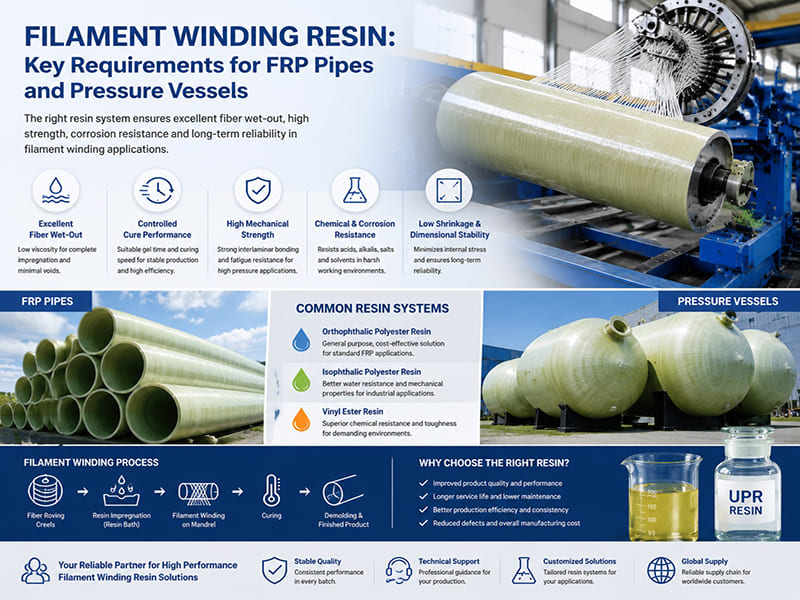
Why Resin Selection Matters in Filament Winding
In filament winding applications, resin performs several key functions:
- Provides strong bonding between fiber layers
- Transfers mechanical loads throughout the composite structure
- Protects reinforcement fibers from environmental damage
- Determines curing behavior and production efficiency
- Improves resistance against chemicals, moisture, and temperature exposure
A properly selected resin system ensures excellent fiber wet-out, low void content, and consistent mechanical performance.
On the other hand, unsuitable resin selection may cause:
- Poor fiber impregnation
- Excessive voids
- Weak interlayer bonding
- Cracking during service
- Reduced pressure resistance
- Shorter product lifespan
Therefore, filament winding manufacturers need to evaluate resin properties according to the final application and operating conditions.
Key Resin Requirements for Filament Winding Applications
1. Suitable Viscosity for Excellent Fiber Wet-Out
Viscosity is one of the most important characteristics of filament winding resin.
During the winding process, resin must effectively penetrate fiber bundles and completely wet the reinforcement material. Proper viscosity helps achieve:
- Better fiber impregnation
- Reduced air entrapment
- Lower void content
- Improved surface quality
If resin viscosity is too high, fiber wet-out becomes difficult and defects may appear inside the composite structure.
If viscosity is too low, resin drainage and uneven distribution may affect product consistency.
A balanced viscosity ensures stable processing and high-quality FRP structures.
2. Controlled Cure Performance
Filament winding production requires predictable curing behavior.
The resin system should provide:
- Suitable gel time
- Stable curing speed
- Controlled exothermic reaction
- Good production flexibility
For large FRP pipes and pressure vessels, uncontrolled curing may create internal stress, deformation, or uneven mechanical properties.
A well-designed resin system allows manufacturers to optimize production speed while maintaining product quality.
3. High Mechanical Strength and Fiber Bonding
FRP pipes and pressure vessels often operate under high mechanical loads and pressure conditions.
The resin must provide strong adhesion between fibers and resin matrix to maximize composite performance.
Important mechanical properties include:
- Tensile strength
- Flexural strength
- Interlaminar bonding strength
- Fatigue resistance
A high-performance resin system helps distribute stress evenly throughout the composite structure and improves long-term reliability.
4. Chemical and Corrosion Resistance
Many filament-wound products are designed for aggressive environments, including:
- Chemical processing plants
- Wastewater treatment facilities
- Oil and gas applications
- Industrial fluid transportation
The resin system must resist:
- Acids
- Alkalis
- Salts
- Solvents
- Moisture exposure
For highly corrosive applications, vinyl ester resin or advanced corrosion-resistant polyester resin systems are commonly selected.
5. Low Shrinkage and Dimensional Stability
During curing, resin shrinkage can influence the final quality of filament-wound products.
Excessive shrinkage may lead to:
- Internal stress
- Microcracks
- Dimensional changes
- Reduced pressure performance
Low-shrinkage resin systems help maintain accurate dimensions and improve structural durability, especially for large diameter pipes and pressure vessels.
Choosing Resin for Different Filament Winding Applications
FRP Pipes
FRP pipes require resin systems with excellent corrosion resistance, mechanical strength, and long-term durability.
Typical requirements include:
- Chemical resistance
- Pressure stability
- Good fiber wet-out
- Low permeability
Common applications include chemical transportation pipelines, water treatment systems, and industrial fluid handling.
FRP Pressure Vessels
Pressure vessels require higher structural performance because they operate under continuous internal pressure.
The resin should provide:
- High tensile performance
- Excellent fiber adhesion
- Fatigue resistance
- Temperature stability
Typical applications include:
- Water treatment vessels
- Reverse osmosis pressure vessels
- Industrial filtration systems
- Gas storage equipment
Common Resin Types Used in Filament Winding
Orthophthalic Polyester Resin
Orthophthalic UPR is commonly used for general FRP applications where cost efficiency and standard performance are required.
Suitable for:
- General industrial pipes
- Non-aggressive environments
- Standard composite products
Isophthalic Polyester Resin
Isophthalic resin provides improved water resistance and mechanical properties.
Suitable for:
- Industrial pipes
- Storage tanks
- Applications requiring better durability
Vinyl Ester Resin
Vinyl ester resin offers excellent chemical resistance and toughness.
It is widely used for demanding applications such as:
- Chemical pipelines
- Pressure vessels
- Corrosive environment equipment
How to Select a Reliable Filament Winding Resin Supplier
For FRP manufacturers, resin consistency and technical support are essential.
A reliable supplier should provide:
Stable Resin Quality
Consistent viscosity, gel time, curing behavior, and mechanical properties ensure stable production.
Application-Based Recommendations
Professional resin suppliers should understand:
- Fiber type
- Winding angle
- Production speed
- Operating environment
- Final performance requirements
Technical Support
Experienced suppliers can help optimize:
- Resin selection
- Catalyst ratio
- Processing parameters
- Production efficiency
ZhongTritium: Your Partner for Filament Winding Resin Solutions
ZhongTritium provides high-performance unsaturated polyester resin solutions for filament winding applications, including FRP pipes, pressure vessels, tanks, and other composite structures.
As an experienced China UPR resin manufacturer, ZhongTritium supports global composite manufacturers with:
- Application-specific resin grades
- Stable product quality
- Technical consultation
- Customized resin solutions
- Reliable supply capability
Our resin systems are designed to help manufacturers improve fiber wet-out, enhance mechanical performance, reduce defects, and achieve reliable long-term operation.
Conclusion
The success of filament winding applications depends heavily on choosing the right resin system. For FRP pipes and pressure vessels, resin properties such as viscosity, curing behavior, chemical resistance, mechanical strength, and shrinkage control directly affect product performance.
By working with an experienced China UPR resin manufacturer like ZhongTritium, manufacturers can obtain optimized resin solutions that improve production efficiency, product reliability, and long-term value.