
In composite manufacturing, selecting the right resin is just as critical as choosing the appropriate production process. Different fabrication methods impose specific requirements on resin viscosity, reactivity, mechanical performance, and processing behavior. Using an unsuitable resin can lead to poor fiber wet-out, defects, reduced strength, or inefficient production.
Among the most widely used composite manufacturing methods are Resin Transfer Molding (RTM), hand lay-up, filament winding, and pultrusion. Each process has distinct characteristics, and therefore requires carefully matched resin systems to achieve optimal performance.
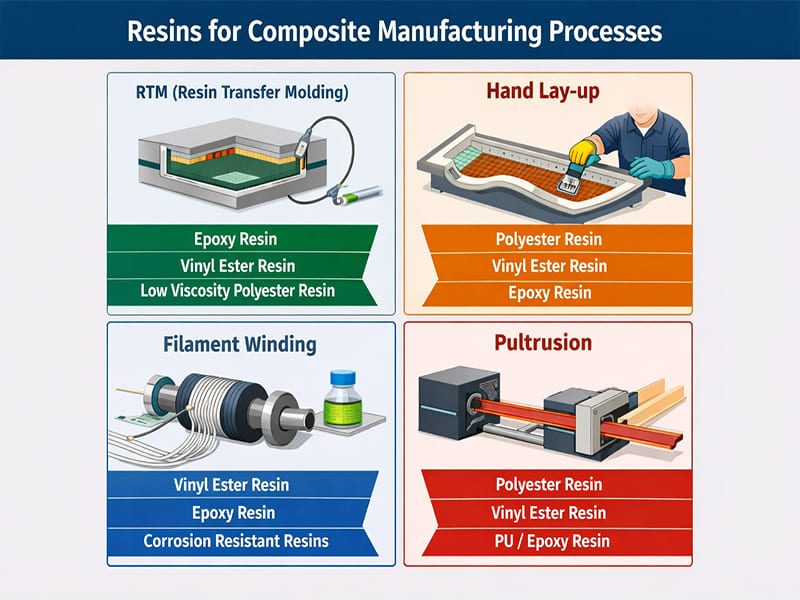
Resin Selection for RTM (Resin Transfer Molding)
RTM is a closed-mold process in which liquid resin is injected into a mold containing dry fiber reinforcements. Because the resin must flow through complex fiber architectures under controlled pressure, low viscosity and excellent flowability are essential.
Resins used for RTM are typically formulated to ensure smooth impregnation without void formation. They must also have controlled curing kinetics, allowing sufficient flow time before gelation begins. Common choices include low-viscosity unsaturated polyester resins, vinyl ester resins, and epoxy systems, depending on the performance requirements.
RTM is widely used in automotive components, electrical housings, and structural panels where dimensional accuracy and surface quality are important.
Resin Selection for Hand Lay-up
Hand lay-up is one of the most traditional and flexible composite manufacturing methods. It involves manually applying resin onto fiber reinforcements, usually in open-mold conditions.
Because this process relies heavily on manual operation, resins must offer good wet-out properties, moderate viscosity, and sufficient working time. A balance between flow and thixotropy is important to prevent excessive resin runoff while still ensuring proper fiber impregnation.
Common resins used in hand lay-up include orthophthalic and isophthalic polyester resins, vinyl ester resins, and epoxy systems. Additives are often incorporated to improve handling, reduce odor, and enhance surface finish.
This process is commonly used in boat building, tanks, molds, and large FRP structures where flexibility and low tooling cost are priorities.
Resin Selection for Filament Winding
Filament winding is a highly controlled process in which continuous fibers are impregnated with resin and wound onto a rotating mandrel to form cylindrical or spherical structures.
In this process, resin systems must exhibit low viscosity for fiber impregnation, stable reactivity, and excellent mechanical and chemical resistance. Since many filament-wound products are used in demanding environments such as pressure vessels or chemical storage tanks, resin durability is critical.
Vinyl ester resins and epoxy resins are commonly used due to their superior corrosion resistance and mechanical strength. Unsaturated polyester resins may also be used in applications where cost efficiency is a priority.
Filament winding is widely applied in the production of pipes, tanks, pressure vessels, and composite cylinders.
Resin Selection for Pultrusion
Pultrusion is a continuous manufacturing process used to produce constant cross-section composite profiles, such as beams, grating, and structural components.
Resins used in pultrusion must have fast curing characteristics, controlled viscosity, and excellent wetting properties to support continuous production. Since the process involves pulling fibers through a heated die, the resin must cure quickly without compromising structural integrity.
Typical resin systems include unsaturated polyester resins, vinyl ester resins, and increasingly polyurethane or epoxy resins for higher performance applications. Flame-retardant and UV-resistant formulations are also commonly required depending on end-use conditions.
Pultrusion is widely used in construction, infrastructure, electrical systems, and industrial applications.
Matching Resin Systems to Manufacturing Requirements
While each process has its own resin requirements, the key to successful composite production lies in aligning resin properties with processing conditions and performance expectations.
Factors such as viscosity, gel time, curing behavior, mechanical strength, and chemical resistance must be carefully balanced. In many cases, customized resin formulations are developed to meet specific manufacturing and application needs.
Conclusion: Optimizing Performance Through the Right Resin Choice
Selecting the correct resin for RTM, hand lay-up, filament winding, or pultrusion is essential to achieving high-quality composite products. Each process places unique demands on resin systems, and understanding these requirements helps manufacturers improve efficiency, reduce defects, and enhance product performance.
As composite applications continue to expand across industries, the role of tailored resin systems becomes increasingly important. By combining the right process with the right resin, manufacturers can achieve the optimal balance between cost, performance, and reliability.
Contact ZhongTritium for Process-Specific Resin Solutions
Choosing the right resin can significantly impact your production efficiency and product performance.
ZhongTritium offers a wide range of unsaturated polyester resins, vinyl ester resins, and customized composite solutions designed for RTM, hand lay-up, filament winding, and pultrusion processes.
Contact us today to discuss your application and find the optimal resin system for your manufacturing needs.