
In today’s highly competitive composites industry, manufacturers are constantly challenged to balance multiple requirements at once: high mechanical performance, lightweight design, environmental compliance, and cost efficiency. Achieving all these goals simultaneously often feels like an impossible task.
However, modern manufacturing technologies are making this balance achievable. In a previous case study featuring China’s first independently developed RoboBoat intelligent electric fishing yacht, the hull was produced using specialized resin systems from AOC together with vacuum infusion technology. This combination successfully delivered a structure that is lightweight, mechanically strong, environmentally friendly, and cost-efficient.
So how does vacuum infusion technology enable manufacturers to achieve these seemingly conflicting goals? Understanding the process helps explain why it has become one of the most widely adopted composite manufacturing methods today.
Why Choose Vacuum Infusion Technology?
Vacuum infusion, also known as Vacuum Infusion Process (VIP), is widely recognized as one of the most advanced and environmentally friendly closed-mold composite manufacturing techniques.
Compared with traditional hand lay-up processes, vacuum infusion offers significant advantages in several areas.
First, it provides a much safer and cleaner working environment. Because the resin is introduced into the laminate under a sealed vacuum bag system, the process minimizes resin spills, dripping, and excessive odor emissions. This closed environment improves workplace safety and reduces environmental impact.
Second, vacuum infusion significantly enhances the mechanical performance of composite parts. Under vacuum conditions, the resin is pulled evenly through the fiber reinforcement, allowing excellent wet-out of glass fiber, carbon fiber, or other reinforcement materials. The resulting laminate typically contains fewer voids and a higher fiber volume fraction—often reaching up to 70%. This leads to components that are both stronger and lighter.
Third, the process improves production efficiency and cost control. The amount of resin introduced into the system can be precisely controlled, reducing material waste. Additionally, the process allows better thickness control and repeatability, which lowers mold costs and shortens manufacturing cycles.
For manufacturers seeking the combination of low odor, high structural strength, and lightweight composite parts, vacuum infusion has become one of the most effective solutions available.
What Is the Vacuum Infusion Process?
Vacuum infusion is a closed-mold composite manufacturing technique that uses vacuum pressure to draw liquid resin through dry fiber reinforcements placed inside a sealed mold system.
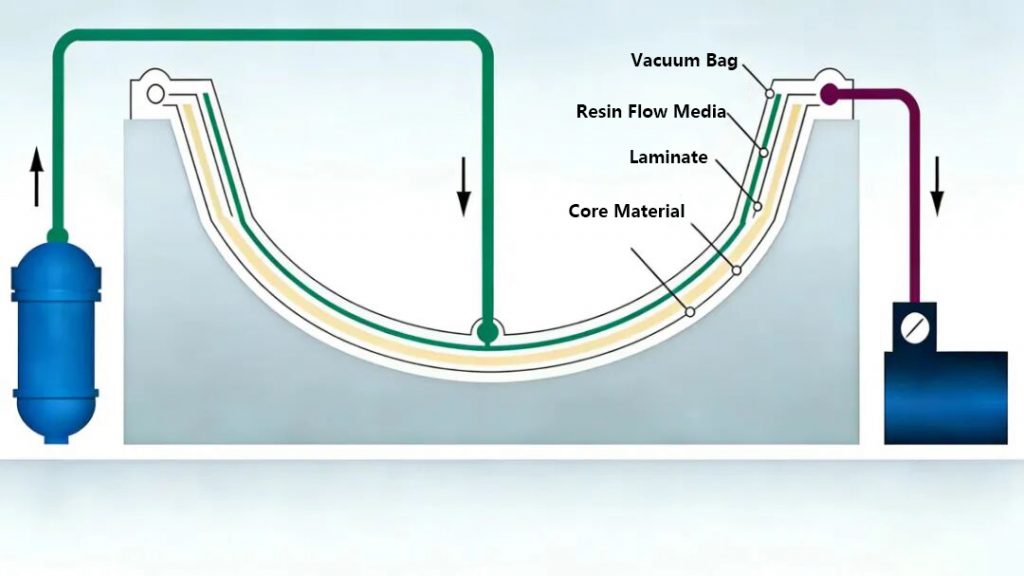
In this process, reinforcement materials such as fiberglass or carbon fiber are first laid dry inside the mold. Once the mold assembly is sealed with a vacuum bag and a vacuum pump is activated, negative pressure removes air from the system. Resin is then introduced through dedicated feed lines and is pulled through the fiber layers by the pressure differential.
As the resin flows through the reinforcement structure, it fully impregnates the fibers before curing into a dense composite laminate with low porosity and excellent mechanical properties.
Because the entire process occurs under controlled vacuum conditions, vacuum infusion can produce high-quality composite parts with superior structural integrity and consistent performance.
Typical Vacuum Infusion Process Steps
Although the concept is straightforward, achieving consistent product quality requires strict adherence to a standardized production workflow. A typical vacuum infusion manufacturing process includes the following key steps:
1.Mold Preparation and Gelcoat Application
The mold surface is carefully cleaned and treated with a release agent to ensure easy demolding. If a smooth or cosmetic surface finish is required, a gelcoat layer is sprayed or brushed onto the mold before the reinforcement materials are placed.
2.Placement of Reinforcement Materials
Dry fiber reinforcements such as fiberglass, carbon fiber fabrics, or stitched mats are arranged inside the mold according to the structural design. Fiber orientation and layer sequencing are critical to achieving the desired mechanical performance.
3.Installation of Auxiliary Materials
Additional materials such as peel ply and flow media are placed on top of the reinforcement layers. These materials help create controlled resin flow channels during infusion and improve resin distribution throughout the laminate.
4.Vacuum Bagging and Sealing
A vacuum bag film is placed over the entire mold assembly and sealed along the mold perimeter to create an airtight system. Proper sealing is essential to maintain stable vacuum pressure during infusion.
5.Connection of Vacuum and Resin Lines
The vacuum pump is connected to the outlet lines, while resin feed lines are connected to a resin container or mixing vessel. These lines form the controlled pathway for resin movement during the process.
6.Vacuum Generation, Leak Testing, and Resin Infusion
The vacuum pump is activated to evacuate air from the system. Once stable vacuum pressure is achieved and leaks are eliminated, resin valves are opened and the resin begins flowing through the reinforcement layers under vacuum pressure.
7.Resin Wet-Out and Curing
The resin continues to flow until all fibers are fully impregnated. Vacuum pressure is maintained during the curing stage to ensure consistent consolidation and minimize void formation.
8.Demolding and Post-Processing
After the resin has cured completely, the vacuum bag and auxiliary materials are removed. The composite component is then demolded and undergoes finishing operations such as trimming, edge processing, and surface inspection.
Each of these steps plays a critical role in determining the final quality of the composite structure.
Key Applications of Vacuum Infusion Technology
Thanks to its ability to produce large, lightweight, and high-performance composite components, vacuum infusion technology has been widely adopted across multiple industries.
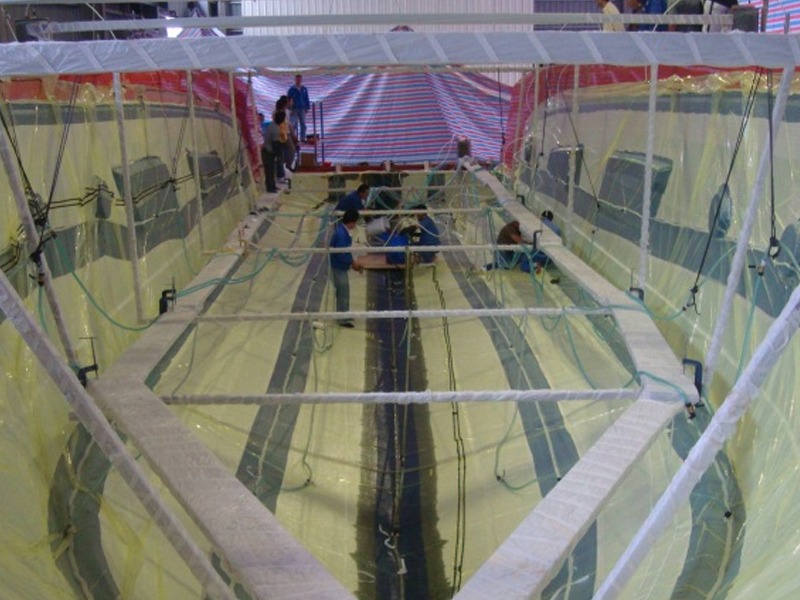
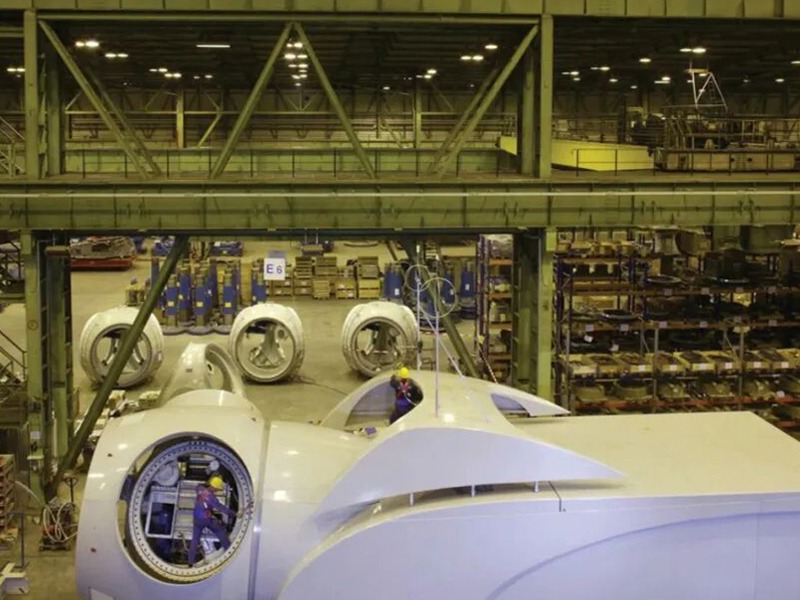
Originally developed for aerospace and other high-performance engineering applications, the technology has gradually expanded into many commercial sectors.
In the wind energy industry, vacuum infusion is used to manufacture large wind turbine blades that require high strength and low weight.
In marine applications, it is widely used for boat hulls, decks, and structural components where corrosion resistance and lightweight design are critical.
The automotive and transportation sectors use vacuum infusion to produce structural composite panels and lightweight body components that improve energy efficiency.
Additionally, the process is commonly applied in aerospace, sports equipment, recreational products, and industrial composite structures.
The common requirement across these industries is the ability to manufacture large, complex, and high-performance composite parts with excellent structural integrity and consistency.
A Key Manufacturing Solution for Modern Composite Production
As industries continue to pursue lighter, stronger, and more environmentally responsible materials, vacuum infusion technology is becoming increasingly important in modern composite manufacturing.
By combining closed-mold processing, precise resin control, and high fiber volume laminates, this technology enables manufacturers to achieve the difficult balance between performance, cost efficiency, and sustainability.
For composite producers seeking to meet demanding engineering requirements while maintaining competitive production efficiency, vacuum infusion represents one of the most reliable and scalable manufacturing solutions available today.
FAQ
What is vacuum infusion in composite manufacturing?
Vacuum infusion is a closed-mold composite process where resin is drawn through dry fibers using vacuum pressure.
What are the advantages of vacuum infusion?
The process improves fiber wet-out, reduces void content, lowers emissions, and enables lightweight high-strength structures.
Which industries use vacuum infusion?
Wind energy, marine vessels, automotive manufacturing, aerospace, and sports equipment industries widely use vacuum infusion.