
Artificial marble, also known as cultured marble or engineered marble, has become a preferred material for countertops, bathroom vanities, decorative panels, and interior architectural applications. Compared with natural stone, artificial marble offers greater design flexibility, more consistent quality, and lower production costs. However, the performance and appearance of the final product depend heavily on one critical material: unsaturated polyester resin (UPR).
As the primary binder in artificial marble formulations, unsaturated polyester resin directly influences surface finish, color clarity, mechanical strength, dimensional stability, and long-term durability. Selecting the right resin is therefore one of the most important decisions manufacturers can make.
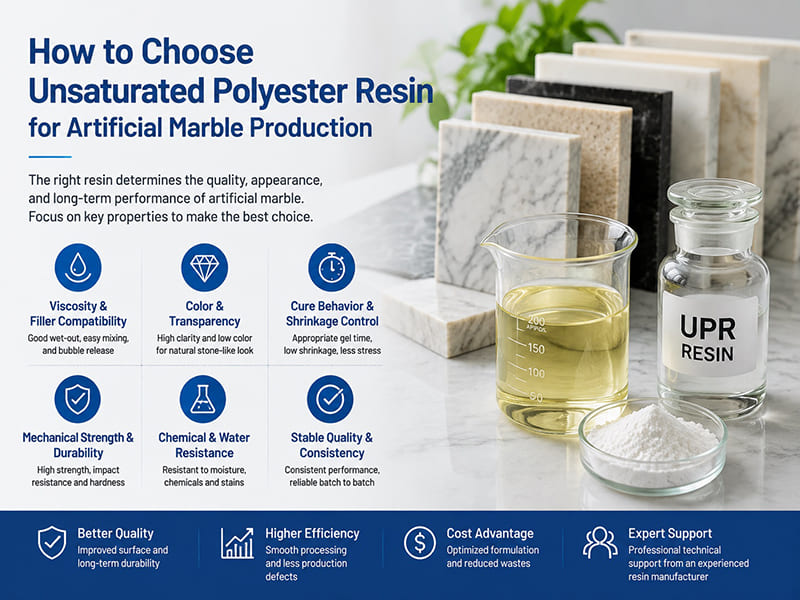
Why Resin Selection Matters
In a typical artificial marble formulation, mineral fillers such as calcium carbonate or aluminum trihydrate account for the majority of the composition, while resin usually represents only 20–35% of the total weight. Despite this relatively small percentage, resin quality has a significant impact on both manufacturing efficiency and finished product performance.
The right resin helps manufacturers achieve:
- Smooth and defect-free surfaces
- Consistent marble-like patterns and color effects
- Reliable curing and demolding performance
- Reduced cracking and warping
- Improved mechanical strength and durability
- Stable batch-to-batch production
Poor resin selection, on the other hand, can lead to air bubbles, surface defects, discoloration, excessive shrinkage, and production inefficiencies.
Understanding Different Resin Types
The first step in resin selection is understanding the different types of unsaturated polyester resin available for artificial marble production.
Orthophthalic polyester resins are widely used for standard indoor applications due to their cost-effectiveness and ease of processing. They provide a practical solution for manufacturers focused on balancing quality and production cost.
Isophthalic polyester resins offer enhanced water resistance, improved mechanical properties, and better long-term durability. They are often selected for higher-end bathroom products and applications exposed to moisture.
DCPD-modified polyester resins provide excellent processing characteristics, low shrinkage, and improved surface quality, making them suitable for premium artificial marble products that require superior appearance and dimensional stability.
Choosing the appropriate resin type should always be based on the intended application, service environment, and performance requirements of the final product.
Viscosity and Filler Compatibility
Artificial marble products typically contain a high percentage of mineral fillers. As a result, resin viscosity plays a critical role in manufacturing performance.
If the resin viscosity is too high, mixing becomes more difficult, air bubbles may become trapped, and filler dispersion can be uneven. Excessively thick resin systems can also increase processing time and create surface defects.
Conversely, if the viscosity is too low, fillers may settle during production, resulting in inconsistent appearance and mechanical properties.
An optimized viscosity ensures:
- Efficient filler wetting
- Smooth mixing and pouring
- Better air release
- Uniform filler distribution
- Improved surface finish
For manufacturers producing large slabs, vanity tops, or decorative panels, selecting a resin specifically formulated for high filler loading can significantly improve production consistency.
Color, Transparency, and Appearance
One of the main reasons customers choose artificial marble is its ability to replicate the appearance of natural stone. Therefore, resin color and transparency are essential considerations.
A low-color, highly transparent resin allows pigments, veins, and decorative effects to appear more vivid and realistic. High-clarity resin systems are especially important when producing white, light-colored, or translucent marble designs.
Resins with excellent color stability also help prevent yellowing during production and throughout the product’s service life. This is particularly important for premium bathroom and interior decoration applications where aesthetics are critical.
Cure Behavior and Shrinkage Control
Proper curing performance directly affects both production efficiency and product quality.
Manufacturers should evaluate:
- Gel time
- Cure speed
- Peak exotherm
- Demolding time
- Room-temperature curing performance
A resin that cures too quickly may reduce processing flexibility, while slow-curing systems can negatively impact productivity.
Equally important is shrinkage control. Excessive shrinkage can create internal stress, warping, surface distortion, and cracking. This becomes especially problematic when manufacturing large artificial marble slabs or thin-profile products.
Low-shrinkage resin systems help maintain dimensional stability and significantly reduce defect rates during production.
Mechanical Performance and Durability
Artificial marble products must withstand daily use while maintaining their appearance over time.
High-quality unsaturated polyester resin contributes to:
- Excellent flexural strength
- Good impact resistance
- Improved hardness
- Enhanced scratch resistance
- Better water resistance
- Long-term dimensional stability
For kitchen countertops, bathroom vanities, and decorative surfaces, selecting a resin with strong mechanical performance helps extend product lifespan and improve customer satisfaction.
Matching Resin to Different Production Processes
Different manufacturing methods require different resin characteristics.
For casting and vacuum molding, low-viscosity, low-shrinkage resins with excellent air-release properties help produce dense, defect-free products.
For continuous slab production, manufacturers often prefer resins with stable curing behavior and excellent color consistency to ensure uniform quality across large panels.
For gel-coated artificial marble products, resin compatibility with the gel coat is essential for achieving strong adhesion and long-lasting surface performance.
Understanding the relationship between resin properties and production methods can significantly improve manufacturing efficiency and product quality.
Common Problems Caused by Incorrect Resin Selection
Many artificial marble defects can be traced back to unsuitable resin systems.
Air bubbles and pinholes often result from poor wetting characteristics or excessive viscosity.
Cracking and warping are frequently associated with high-shrinkage resin systems or uncontrolled curing reactions.
Yellowing and poor color consistency may occur when low-quality or unstable resin grades are used.
Soft spots, poor hardness, and staining issues can result from incomplete curing or inadequate chemical resistance.
Selecting a resin specifically developed for artificial marble production helps minimize these risks and improve overall production reliability.
Why Work with a Specialized China UPR Resin Manufacturer?
Choosing the right supplier is just as important as choosing the right resin.
An experienced China UPR resin manufacturer can provide more than just raw materials. They can offer formulation expertise, processing recommendations, and technical support tailored to your production requirements.
At ZhongTritium, we specialize in supplying unsaturated polyester resin solutions for artificial marble, cultured marble, engineered stone, and composite applications. Our technical team works closely with manufacturers to optimize resin selection based on filler systems, production processes, curing conditions, and performance targets.
As a professional unsaturated polyester resin manufacturer, we provide:
- Dedicated resin grades for artificial marble production
- Consistent batch-to-batch quality
- Technical support for process optimization
- Sample evaluation and testing assistance
- Reliable global supply capability
Our goal is to help customers improve production efficiency, reduce defects, and achieve superior product performance.
Conclusion
Choosing the right unsaturated polyester resin is the foundation of successful artificial marble production. Factors such as resin type, viscosity, transparency, curing behavior, shrinkage control, and mechanical strength all influence the appearance, durability, and manufacturing efficiency of the final product.
By partnering with an experienced China UPR resin manufacturer like ZhongTritium, manufacturers can gain access to tailored resin solutions, professional technical support, and reliable product quality that help ensure long-term success in the competitive artificial marble market.
Looking for the right resin for your artificial marble project? Contact ZhongTritium today to discuss your production requirements and discover customized resin solutions designed for your manufacturing process.