
Air bubbles are one of the most common quality issues in FRP (Fiber-Reinforced Plastic) manufacturing. They negatively affect surface appearance, mechanical strength, and long-term durability of composite products.
While processing conditions and operator techniques play important roles, resin formulation itself is a critical and often underestimated factor in controlling bubble formation.
This article analyzes the root causes of air bubbles in FRP products from a resin formulation perspective and discusses practical approaches to minimize them.
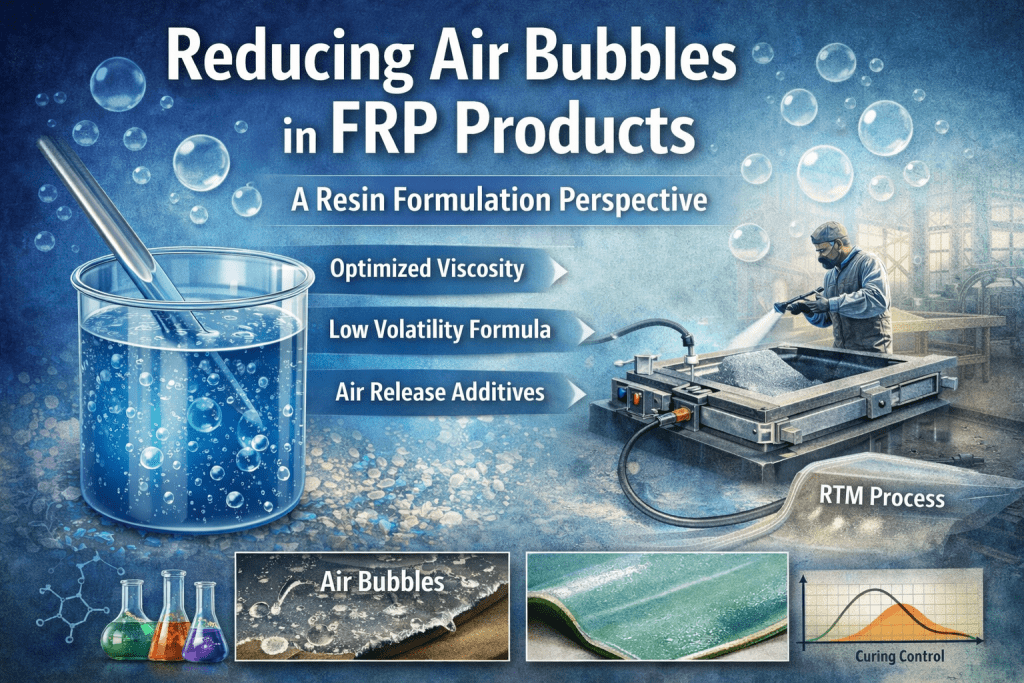
Main Sources of Air Bubbles in FRP Products
From a materials standpoint, air bubbles in FRP composites typically originate from:
- Entrapped air during resin impregnation
- Dissolved gases released during curing
- Volatile components evaporating under exothermic reaction
- Poor resin flow preventing effective air release
A well-designed resin formulation can significantly reduce these risks before processing even begins.
Resin Viscosity: The Foundation of Bubble Control
Resin viscosity directly influences air release and fiber wet-out efficiency.
- High viscosity resins trap air more easily, especially in hand lay-up and filament winding processes.
- Excessively low viscosity resins, however, may increase air entrapment during mixing or cause resin drainage.
An optimized viscosity window ensures:
- Proper fiber impregnation
- Smooth air escape during lamination
- Stable processing behavior across different temperatures
Modern UPR and vinyl ester formulations are often tailored to match specific processing methods such as RTM, pultrusion, or spray-up.
Low-Volatility Reactive Systems
Volatile components in resin systems are a major source of bubbles during curing.
From a formulation perspective, this includes:
- Styrene content and evaporation rate
- Low-boiling reactive diluents
- Residual solvents or impurities
Reducing volatility through:
- Optimized monomer ratios
- Controlled molecular weight distribution
- High-purity raw materials
can significantly lower gas generation during curing and improve laminate integrity.
Role of Defoaming and Air-Release Additives
Defoaming agents and air-release additives play a key role in bubble reduction when properly formulated.
Effective additives should:
- Promote bubble coalescence and escape
- Remain compatible with the resin matrix
- Avoid negative impact on mechanical properties or surface finish
Balanced additive selection is especially important for applications requiring high surface quality, such as sanitary ware, molds, and visible FRP components.
Cure Kinetics and Exotherm Control
Curing behavior strongly affects bubble formation.
- Rapid curing systems may trap air before it has time to escape
- High exothermic peaks can cause dissolved gases to expand suddenly
From a formulation standpoint, controlling cure kinetics through:
- Initiator type and concentration
- Inhibitor balance
- Resin reactivity design
helps ensure a gradual gelation process, allowing trapped air to release before solidification.
Resin Compatibility with Processing Methods
Different FRP processes place different demands on resin behavior.
For example:
- RTM and vacuum infusion require excellent flow and air-release performance
- Pultrusion demands consistent viscosity and low gas evolution
- Hand lay-up benefits from longer open time and controlled thixotropy
A formulation optimized for the specific process significantly reduces bubble-related defects.
Conclusion
Reducing air bubbles in FRP products is not solely a processing challenge—it begins with resin formulation design.
By optimizing viscosity, minimizing volatile components, controlling cure behavior, and incorporating suitable air-release additives, resin systems can greatly improve laminate quality and production consistency.
A formulation-driven approach enables manufacturers to achieve:
- Better surface finish
- Higher mechanical performance
- Lower rejection rates
- More stable and predictable production outcomes
As FRP applications continue to expand into high-performance and appearance-critical markets, resin formulation will remain a key factor in bubble control and overall composite quality.