
In composite manufacturing, resin selection is never a one-size-fits-all decision. Even when using the same fiberglass or carbon fiber reinforcement, different production processes place very different demands on resin viscosity, curing behavior, and final performance. Understanding how resin systems interact with RTM, hand lay-up, filament winding, and pultrusion helps manufacturers improve product quality while keeping production efficient and stable.
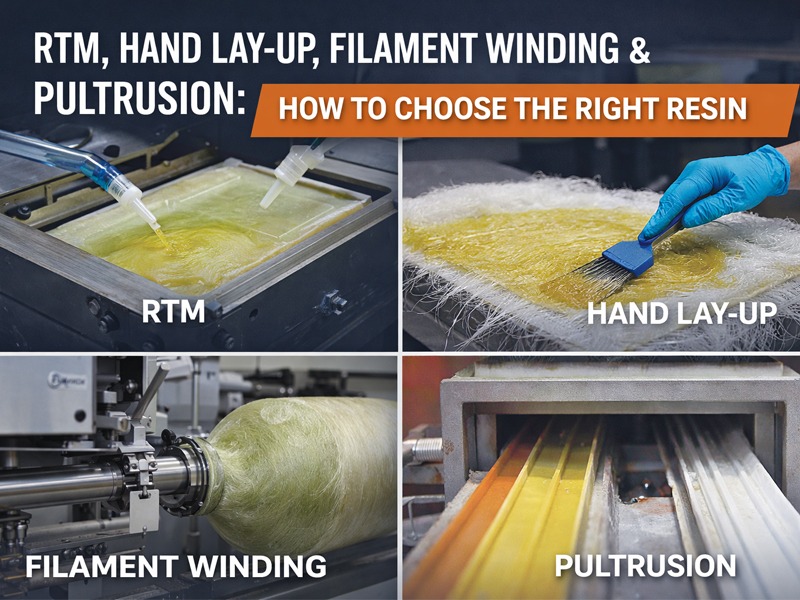
Resin Requirements for RTM (Resin Transfer Molding)
RTM is a closed-mold process where resin is injected into a mold containing dry fiber preforms. Because the mold is sealed, resin flow behavior becomes one of the most critical factors.
Resins used for RTM typically need very low viscosity to ensure complete fiber wet-out and avoid dry spots. At the same time, gel time must be carefully controlled—long enough for full mold filling, yet short enough to maintain productivity.
Low-viscosity unsaturated polyester resins are widely used for standard RTM parts, while vinyl ester resins are often selected when higher chemical resistance or mechanical performance is required. In applications such as automotive panels, enclosures, and structural housings, low shrinkage and surface quality are also key considerations.
Hand Lay-Up: Flexibility and Workability Matter
Hand lay-up remains one of the most commonly used open-mold processes, especially for large or custom-shaped products. In this process, resin is manually applied to fiber layers, making workability and pot life especially important.
Resins for hand lay-up usually have medium viscosity, allowing easy fiber impregnation without excessive dripping. A stable curing profile helps operators work comfortably while maintaining consistent laminate quality.
General-purpose UPR is widely used for cost-sensitive applications, while low-shrink or high-performance vinyl ester resins are preferred for sanitary ware, marine components, and corrosion-resistant FRP tanks where surface finish and durability are critical.
Filament Winding: Strength, Adhesion, and Chemical Resistance
Filament winding is a highly controlled process used for producing pipes, pressure vessels, and storage tanks. Continuous fibers are impregnated with resin and wound under tension, meaning the resin must deliver excellent fiber adhesion and mechanical strength.
Resins used in filament winding typically have low to medium viscosity to ensure uniform fiber wet-out, combined with strong bonding to reinforcement fibers. For chemical tanks, pipelines, and industrial vessels, vinyl ester resins are often favored due to their superior resistance to acids, alkalis, and solvents.
In applications involving high pressure or demanding mechanical loads, epoxy resins may also be selected to maximize strength and fatigue resistance.
Pultrusion: Consistency and Fast Cure Are Key
Pultrusion is a continuous manufacturing process used to produce constant cross-section profiles such as gratings, beams, ladders, and cable trays. Unlike batch processes, pultrusion demands stable viscosity and rapid, consistent curing.
Pultrusion-grade unsaturated polyester resins are commonly used due to their balanced performance and cost efficiency. For outdoor or corrosive environments, vinyl ester resins offer enhanced durability and longer service life. In infrastructure projects, flame-retardant or low-smoke resin systems may also be required to meet safety standards.
A well-matched pultrusion resin ensures smooth production, reduced downtime, and consistent mechanical properties across long production runs.
Matching Resin Performance with Process Needs
Selecting the right resin starts with understanding the process itself. Factors such as viscosity, curing speed, shrinkage, mechanical strength, and chemical resistance all influence final product performance.
RTM focuses on flow and mold filling, hand lay-up emphasizes workability, filament winding demands strength and corrosion resistance, while pultrusion requires speed and stability. Aligning resin characteristics with these requirements helps manufacturers reduce defects, improve surface quality, and achieve more reliable production results.
This process-oriented approach to resin selection is becoming increasingly important as composite applications expand into automotive, chemical, construction, and environmental industries—where performance expectations continue to rise.