
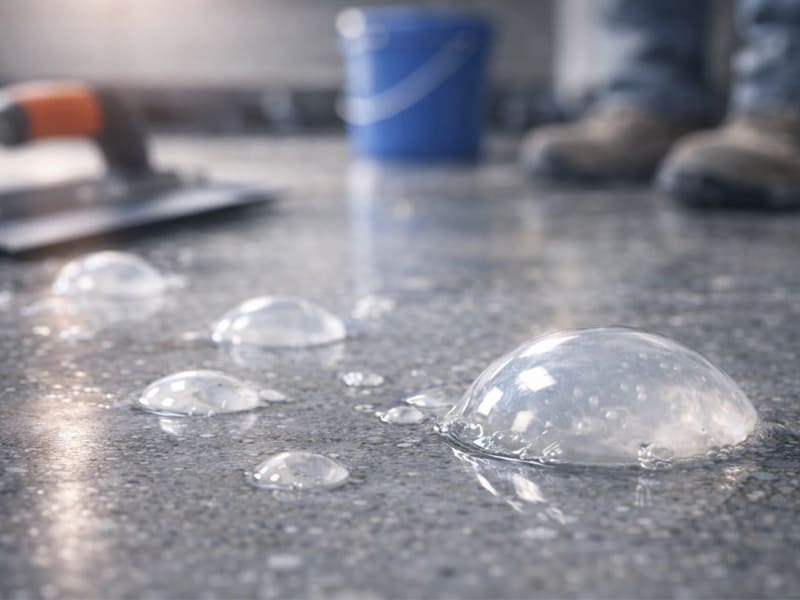
Permeability blistering, often called osmotic blistering, is one of the most persistent failures in epoxy coatings and industrial flooring systems. It appears as raised bubbles or dome-shaped defects beneath the surface, often filled with fluid.
Although it may begin as a cosmetic issue, blistering quickly signals deeper problems: moisture intrusion, loss of adhesion, and compromised long-term durability.
Understanding why blistering occurs is the first step toward preventing costly repairs.
Moisture Vapor Emission from Concrete
Concrete is naturally porous and constantly interacts with moisture. Even when the surface appears dry, internal moisture can migrate upward through capillary action.
When an impermeable epoxy layer is applied over a slab with elevated moisture levels, vapor pressure builds beneath the coating. Over time, this trapped pressure forces separation between the epoxy and the substrate, forming visible blisters.
This is the most common and most underestimated cause of permeability failure.
Inadequate Surface Preparation
Surface preparation directly determines bond strength. Residual oils, curing agents, laitance, salts, or fine dust create weak interfaces between the epoxy and substrate.
These weak zones allow moisture to accumulate and travel laterally beneath the coating. Once moisture movement begins, delamination and blister formation accelerate.
Even the highest-quality resin cannot compensate for poor mechanical preparation.
Incorrect Product Selection
Not all epoxy systems are designed to handle high moisture vapor transmission. Decorative coatings optimized for gloss and appearance may lack the vapor resistance required for ground-level or below-grade installations.
In humid or chemically aggressive environments, using a standard epoxy instead of a vapor-tolerant system significantly increases blistering risk.
Material compatibility with the installation environment is critical.
Application and Curing Errors
Improper resin-to-hardener ratios, insufficient mixing, excessive film thickness, or curing outside recommended temperature and humidity ranges can create micro-defects within the coating.
Uneven polymerization increases permeability and introduces internal stress points where blisters can initiate under pressure.
Application discipline is as important as material selection.
A Systematic Approach to Prevention
Blistering rarely results from a single mistake. It is usually the consequence of several small oversights accumulating over time.
Prevention therefore requires a comprehensive strategy rather than isolated corrections.
Moisture evaluation should be treated as a mandatory engineering step. Reliable in-situ relative humidity testing provides a clear picture of slab conditions and determines whether moisture mitigation systems are necessary before coating installation.
Professional mechanical surface preparation establishes a uniform bonding profile. Grinding or shot blasting removes contaminants completely and creates the texture required for long-term adhesion stability.
Selecting vapor-tolerant primers and moisture-resistant epoxy systems ensures the coating is engineered for the environmental load it will face. Designing the system based on site conditions dramatically reduces future failure risk.
Finally, strict control of mixing ratios, blending time, film thickness, and ambient curing conditions ensures uniform cross-linking and minimizes permeability weaknesses.
Long-Term Performance Starts Before Installation
Permeability blistering is preventable. When moisture testing, surface preparation, material selection, and application control are integrated into a unified process, epoxy systems can achieve their intended service life.
In demanding industrial environments, prevention is not an extra step — it is the foundation of durability.